Home > Drag and Drop Questions

Drag and Drop Questions

March 4th, 2012 in SWITCH 642-813 Go to comments

Here you will find answers to Drap and Drop questions

Question 1:

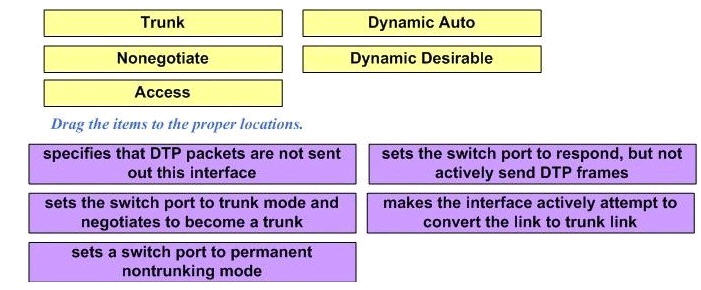
Place the DTP mode with its correct description:
DTP_modes


Answer:

1) Trunk: Set the switch port to trunk mode and negotiate to become a trunk.
2) Nonegotiate: Specify that the DTP packets are not sent out of this interface.
3) Access: Set a switch port to permanent nontrunking mode.
4) Dynamic Auto: Set the switch port to respond, but not actively send DTP frames.
5) Dynamic Desirable: Make the interface actively attempt to convert the link to a trunk link. (This means the interface is ready to autonegotiate trunking encapsulation and form a trunk link (using DTP) with a neighbor port in desirable, auto, or on mode.)

Explanation:

Dynamic Trunking Protocol (DTP) is the Cisco-proprietary that actively attempts to negotiate a trunk link between two switches. Below is the switchport modes (or DTP modes) for easy reference:

Mode Function
Dynamic Auto Creates the trunk based on the DTP request from the neighboring switch.
Dynamic Desirable Communicates to the neighboring switch via DTP that the interface would like
to become a trunk if the neighboring switch interface is able to become a trunk.
Trunk Automatically enables trunking regardless of the state of the neighboring switch
and regardless of any DTP requests sent from the neighboring switch.
Access Trunking is not allowed on this port regardless of the state of the neighboring
switch interface and regardless of any DTP requests sent from the neighboring
switch.
Nonegotiate Prevents the interface from generating DTP frames. This command can be
used only when the interface switchport mode is access or trunk. You must
manually configure the neighboring interface as a trunk interface to establish a
trunk link.

Question 2:

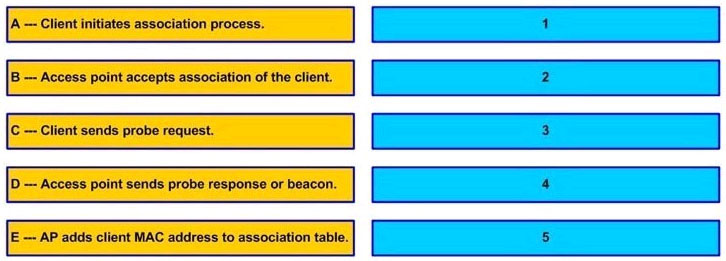
This is a drag and drop question which is about the correct sequence of steps that a wireless client takes during the process of association with an access point (AP). Drag the items to the proper locations.
wireless_association.jpg


Answer:

wireless_association_answer.jpg

Explanation:

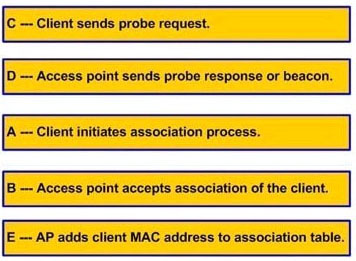
Any wireless client attempting to use the wireless network must first arrange a membership with the AP. Membership with the AP is called an association. The client must send an association request message, and the AP grants or denies the request by sending an association reply message. Once associated, all communications to and from the client must pass through the AP. Clients associate with access points as follows:

1) The client sends a probe request.
2) The AP sends a probe response.
3) The client initiates an association to an AP. Authentication and any other security information is sent to the AP.
4) The AP accepts the association.
5) The AP adds the client’s MAC address to its association table.

Question 3:

Drag and drop question. Drag the items to the proper locations.
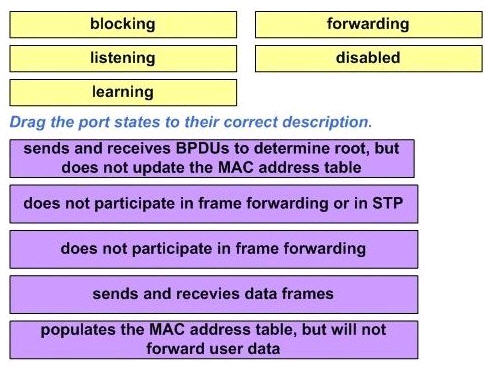
STP_process


Answer:

STP_process_answer

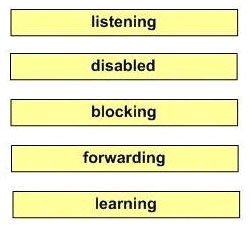
1) Listening: sends and receives BPDUs to determine root, but does not update the MAC address table.
2) Disabled: does not participate in frame forwarding or in STP.
3) Blocking: does not participate in frame forwarding.
4) Fowarding: sends and receives data frames.
5) Learning: populates the MAC address table, but will not forward user data.

Notice: A port begins its life in a Disabled state, moving through several passive states and, finally, into an active state if allowed to forward traffic.

Question 4 (not sure about the question)

network level – RSTP, NSF
system level – Dual power supply, SSO
management level – NTP , IP SLA

verify that the vlan is assigned to the proper ports
verify that creation of the virtual interface
Verify that there is inter-switch connectivity
verify that switchports are properly pruned

Number of IP Subnets
VLAN to IP mapping
Location of each VLAN
VLAN assignments

Comments
Comment pages
1 2 3 27
  1. Anonymous
    August 27th, 2010

    Is there any chance someone could post the Implementing Vlans Drag and Drop? Thank You

  2. a
    August 30th, 2010

    As well as SNMP, SYSLOG, ETC.

    Thank You.

  3. Nico
    August 30th, 2010

    @a: I second that! :)

  4. Anonymous
    September 2nd, 2010

    Drag and Drop Question, have no idea what the answer is … any1 got any ideas ?

    Drag the network requirements on the left to the boxes on the right that are needed network resources for implementing a VLAN-based network solution. Not all choices will be used.

    Options:
    Number of IP Subnets
    Trunking VTP arrangements
    VLAN to IP mapping
    VLAN assignments
    Location of each VLAN
    End-to-end Dynamic Trunking Assignments

    Select 4 options.

  5. Anonymous
    September 2nd, 2010

    Another Drag and Drop: answer away if you have any ideas

    Drag the steps on the left that should be part of a VLAN-based verification plan to the spaces on the right. Not all choices will be used.

    Options:
    Verify that Switchports are properly pruned
    Verify that there is inter-switch connectivity
    Verify that inter-switch connectivity
    Verify that creation of the virtual interface
    Verify that the VLAN ports are in promiscuous mode
    Verify that the VLAN is assigned to the proper ports

    Need to select 4 options…

  6. heiko
    September 3rd, 2010

    promiscous mode is only used in PVLANs
    the inter-switch connectivity answer ist duplicate

    then are left over 4 answers

  7. vasanth
    September 6th, 2010

    1Verify that there is inter-switch connectivity
    2Verify that creation of the virtual interface
    3Verify that the VLAN is assigned to the proper ports
    4Verify that Switchports are properly pruned

  8. TO FERRADO
    September 8th, 2010

    someone see drag and drop about system management and so one. You have to put in nsf, sso, and more?

  9. oxi2
    September 10th, 2010

    CCNP Switch pass with 908, the same labs. The Drag and Drop are different. the same that says the anonymous and one more about management, network and system features like IP SLA, NTP,SSO,STP and Power environment.

    the older drag and drop does not appear, Cisco have retired them. And the labs only that appear are inter-vlan with Eigrp, dot1x and implementing vlans with etherchannel in lacp mode.

  10. oxi2
    September 10th, 2010

    Management
    IPSLA
    SSO

    Network
    NTP
    NSF

    System
    POWER
    RSTP

  11. akaEvgen
    September 13th, 2010

    it’s right?

    Network
    NTP
    NSF(?)

    SYSTEM
    POWER
    RSTP(?)

  12. oxi2
    September 13th, 2010

    yes, its right. i had 100% in Ip services. I only had 75% in vlan-implementation without sets of requirements. The other 100%.

  13. oxi2
    September 13th, 2010

    in system there is something related with Device Power. Thats dragged to System.

  14. Anonymous
    September 13th, 2010

    I think this is more correct:

    Management:
    IP SLA
    NTP

    Network:
    RSTP
    NSF

    SYSTEM:
    Power Suppy
    SSO

    ????????????????

  15. akaEvgen
    September 13th, 2010

    Managment
    -ip sla
    -ntp
    Network
    -rstp
    -nsf
    System
    -power
    -sso

    I think that’a right
    http://www.ciscosystems.com/en/US/docs/switches/datacenter/sw/4_0/nx-os/high_availability/configuration/guide/ha_network.html

    May be need to create topic with right answers? sorry for my english=)

  16. akaEvgen
    September 14th, 2010

    where i can read about vlan-based implementation verification plan?

  17. Kash
    September 14th, 2010

    System
    SSO and NSF as both use for Supervisor redudancy

    Network
    RSTP and IP SLA

    Managament
    NTP and Dual power supply

    This answer by TI new exam

  18. Kash
    September 14th, 2010

    Right answer is

    Verify that Switchports are properly pruned
    Verify that inter-switch connectivity
    Verify that the VLAN ports are in promiscuous mode
    Verify that the VLAN is assigned to the proper ports

  19. akaEvgen
    September 15th, 2010

    @Kash please read http://www.ciscosystems.com/en/US/docs/switches/datacenter/sw/4_0/nx-os/high_availability/configuration/guide/ha_network.html. Nsf is a network layer redundacy, because realayed on network layer protocols such as eigrp ospf bgp.

  20. akaEvgen
    September 15th, 2010

    Does any one have any answer to this D & D
    Options:
    -Number of IP Subnets
    -Trunking VTP arrangements
    -VLAN to IP mapping
    -VLAN assignments
    -Location of each VLAN
    -End-to-end Dynamic Trunking Assignments
    Select 4 options.
    Anybody now 100% right answer?

  21. akaEvgen
    September 15th, 2010

    from http://certcollection.org/forum/topic/34807-d-d/
    choose from 6 options required 4

    Ip assignment is neccessary .. ..

    VLAN location
    amount of IP subnets
    VLAN to IP subnet mapping
    VLAN assignments
    end-to-end dynamic trunking
    VTP trunking assignments

    help me with the Ans??????

    Ans.
    VLAN Location
    amount of IP subnets
    VLAN to IP subnet mapping
    VLAN assignments

    it’ s right?

  22. akaEvgen
    September 15th, 2010

    @Kash
    -Verify that Switchports are properly pruned(?)
    i think vlan pruned on trunks port instead switchport.

  23. Kash
    September 15th, 2010

    Well Its not my answer,This is TI latest release answer.I am not sure both as its very confusing,I hope TI not given wrong answer?

  24. akaEvgen
    September 15th, 2010

    @Kash can you share link to new TI or mail to akaevgen@gmail.com? thanks.
    what ti answer for
    Does any one have any answer to this D & D
    Options:
    -Number of IP Subnets
    -Trunking VTP arrangements
    -VLAN to IP mapping
    -VLAN assignments
    -Location of each VLAN
    -End-to-end Dynamic Trunking Assignments
    Select 4 options?

  25. Kash
    September 15th, 2010

    @akaEvgen Nope this question not there in new TI, I have TI engine which can not be shared as its software,But all question is same as old TI by jaykay.

  26. akaEvgen
    September 15th, 2010

    i can’t understand why dual power is a mangment level?
    I found the student guide http://www.scribd.com/doc/35949441/Cisco-CCNP-SWITCH-642-813-Student-Guide-Volume-2.
    high availability module self-check q3
    which in an example of system redundancy
    answer: redudant power supplies.
    i think something wrong in new TI. May be mistake?

  27. akaEvgen
    September 15th, 2010

    my conclusion about D&D Vlan Design for end-to-end design is
    -number of ip subnets
    -vlan to ip mapping
    -Location of each VLAN
    -Trunking VTP arrangements

    this steps from
    http://www.scribd.com/doc/35949334/Cisco-CCNP-SWITCH-642-813-Student-Guide-Volume-1

  28. Kash
    September 15th, 2010

    THis is what I found ,

    Management

    Q. Does the Cisco RPS 2300 offer enhanced management features when connected to Cisco switches?
    A. Yes. The Cisco RPS 2300 offers enhanced management capabilities when attached to Cisco Catalyst 3750-E and 3560-E Series Switches.
    Q. What new management features are available on the Cisco RPS 2300?
    A. Provided the Cisco RPS 2300 is connected to a Cisco Catalyst 3750-E or 3560-E Series Switch, it provides users with the following additional management features:
    • The ability to remotely place the RPS (and all six DC ports) in active or standby mode.

    • The ability to report if one or two RPS power supply modules are present in the Cisco RPS 2300, as well as their status.

    • The ability to report a list of connected switches and their power requirements.

    • The ability to report which switches are being supplied power from the Cisco RPS 2300.

    • The ability to configure switch priority.

  29. CARAMBA
    September 15th, 2010

    Alguém pode se decidir e colocar a informação correta aqui?

  30. CARAMBA
    September 15th, 2010

    I will do the test friday, someone here can put the correct answers here.

  31. Ashraf
    September 16th, 2010

    Guys dont confuse wright sequence are—–

    -Number of IP Subnets
    -Location of each VLAN
    -VLAN assignments
    -Trunking VTP arrangements

  32. Kash
    September 17th, 2010

    @Ashraf, Are you sure about above answer? and anyone provide answer for below D&D.I have new TI answer but it looks like wrong.

    1)
    1)Verify that switchports are properly pruned
    2) Verify that there is inter-swich connectivity
    3) Verify that inter-switch connectivity.
    4) Verify that creation of virtual interface
    5) Verify that the VLAN assigned to the proper ports
    6) Verify that VLAN ports are in promiscous mode

    and 2) Management , System, Network D&D

  33. vin
    September 17th, 2010

    Ashraf is correct, my Test1pass latest version Aug 347 question .

    http://www.megaupload.com/?d=LY2UNWFC

  34. Anonymous
    September 18th, 2010

    @vin can you share Test1pass akaevgen@gmail.com

  35. Anonymous
    September 20th, 2010

    what means Trunking VTP arrangements?
    why vlan-to-ip mapping not in the plan?

  36. Anonymous
    September 20th, 2010

    1)Verify that switchports are properly pruned
    2) Verify that there is inter-swich connectivity
    3) Verify that inter-switch connectivity.
    4) Verify that creation of virtual interface
    5) Verify that the VLAN assigned to the proper ports
    6) Verify that VLAN ports are in promiscous mode
    I think
    1) Verify that inter-switch connectivity.
    2) Verify that creation of virtual interface
    3) Verify that the VLAN assigned to the proper ports
    4) Verify that switchports are properly pruned

    test1pass 100% right?

  37. Anonymous
    September 20th, 2010

    this new D&D is crazy, nobody can’t post 100% right answer!

  38. akaEvgen
    September 21st, 2010

    syslog priority
    emergency
    alert
    critical
    error
    warning
    notice
    informational
    debug

    from highest to lower
    highest does mean emergency(0) ?? and lowest low-level logging?

  39. Opal
    September 21st, 2010

    aKaEvgen:

    Yes, Syslog priority is ranked highest from Emergency (0) to lowest Debugging (7).

  40. Opal
    September 21st, 2010

    Mgmt:

    NTP
    IP SLA

    Sys:

    Power (yes according to Cisco Student Guide!)
    SSO (L2)

    Network:

    RSTP
    NSF (L3)

  41. akaEvgen
    September 22nd, 2010

    @Opal what you think about ?
    Does any one have any answer to this D & D
    Options:
    -Number of IP Subnets
    -Trunking VTP arrangements
    -VLAN to IP mapping
    -VLAN assignments
    -Location of each VLAN
    -End-to-end Dynamic Trunking Assignments
    Select 4 options?

  42. kash
    September 22nd, 2010

    Question is drag to right appropriate resiliency or management level .
    so its confuse if SSO should be with NSF ?
    and IP SLA responder is Network layer as u need to implement in switch ?
    Dual power supply is again coming to management level as per switch RPS?

  43. akaEvgen
    September 22nd, 2010

    not confuse. read the link above.

  44. niche
    September 29th, 2010

    @akaEvgen:

    The answer to your question is

    Number of IP subnets
    Location of each VLAN
    VLAN assignments
    VLAN to IP mappings

  45. Bob
    September 29th, 2010

    @akaEvgen

    As it is a vlan-based implementation plan, trunking shouldn’t be dynamic.
    And trunking VTP arrangements is not necessary either.
    I believe niche is correct.

  46. Bob
    September 29th, 2010

    Hi,

    Anyone has the proper answer to this question please? Thanks.

    http://yfrog.com/ev15869048j

  47. Bob
    September 29th, 2010

    Sorry. Wrong link provided. Answer to this question please.

    http://img535.imageshack.us/img535/4049/15869048.jpg

  48. niche
    September 30th, 2010

    Hey Bob,

    this is the correct sequence:
    Verify that there is inter-switch connectivity
    verify that creation of the virtual interface
    verify that the vlan is assigned to the proper ports
    verify that switch are properly pruned

  49. S
    October 1st, 2010

    Here’s my guess :)

    Verify that Switchports are properly pruned
    Verify that there is inter-switch connectivity
    Verify that inter-switch connectivity
    Verify that creation of the virtual interface
    Verify that the VLAN ports are in promiscuous mode
    Verify that the VLAN is assigned to the proper ports

    ‘Switchports are properly pruned’ should be wrong I guess, VLAN’s are pruned, not switchports and only on trunk links.

    ‘VLAN ports are in promiscuous mode’ should also be wrong I guess, promiscuous mode is only used in PVLAN and the question no where states the use of PVLAN. Besides in a PVLAN not all ports should be in promiscuous mode but only the port that connects to a router, gateway or common device. Other PVLANs/ports should be in isolated mode or community mode. Besides, what the hell is a ‘VLAN port’, is that a access mode switch port with the proper VLAN assigment, a SVI or what??

    ‘Verify that there is inter-switch connectivity’ Sounds correct, verify the connectivity with other switches.

    ‘Verify that inter-switch connectivity’ Sounds very similar to the previous one but they probably mean checking the inter-switch link is working ok (properly trunking, native vlan, allowed vlan, pruning, DTP etc.). Should state ‘Verify that the inter-switch connectivity is working properly’ instead of this strange blurb.

    ‘Verify that creation of the virtual interface’, should be correct

    ‘Verify that the VLAN is assigned to the proper ports’, should be correct as well (sw access vlan xxx to the access interfaces)

    I found some questions to be really strange in their descriptions or answers, very vague leaving you to wonder what the hell they are on about.

  50. andy
    October 6th, 2010

    Can anyone tell me whether VOIP and WLAN are included in the exam now?

  51. Giorgio
    October 12th, 2010

    4 Andy
    Yes they are included

  52. ciscoholic
    October 16th, 2010

    This is the correct answer

    Management:
    IP SLA
    NTP

    Network:
    RSTP
    NSF

    SYSTEM:
    Power Suppy
    SSO

  53. ciscoholic
    October 25th, 2010

    Another D&D

    IP Routing
    Voice
    Interactive Video
    Streaming video
    Call Signaling
    NetworkManagement

    http://www.cisco.com/en/US/technologies/tk543/tk759/technologies_white_paper0900aecd80295a9b.pdf

  54. Sh@Z
    October 27th, 2010

    I M still confuse about the answer of this question..

    -Number of IP Subnets
    -Trunking VTP arrangements
    -VLAN to IP mapping
    -VLAN assignments
    -Location of each VLAN
    -End-to-end Dynamic Trunking Assignments

  55. Anonymous
    November 1st, 2010

    This is correct sequence:

    - Number of IP Subnets (prior to implement vlan solution)
    - Location of each vlan (this is related to local vlan as which switch block it related to)
    - Vlan assignments (Vlan assignment to the ports)
    - Vlan to IP mapping (creating virtual interface, configure IP address and routing)

    The followings do not seems to be correct choice:

    - End-to-end dynamic trunking assignments
    - Trunking VTP arrangement

  56. gbulan
    November 2nd, 2010

    @ciscoholic

    based on the link you attached, the order should be as below:

    QOS baseline model:
    voice
    interactive video
    streaming video
    call signalling
    IP routing
    network management

  57. abc
    November 6th, 2010

    for this DD
    - Number of IP Subnets
    - Location of each vlan
    - Vlan assignments
    - Vlan to IP mapping
    - End-to-end dynamic trunking assignments
    - Trunking VTP arrangement

    answer for TK is
    - Number of IP Subnets
    - Location of each vlan
    - Vlan assignments
    - Vlan to IP mapping

    so what is the correct answer?

  58. abc
    November 6th, 2010

    sorry
    answer on TK is
    -Number of IP Subnets
    - Location of each vlan
    - Vlan assignments
    -Trunking VTP arrangement

  59. sarath k
    November 10th, 2010

    new d d question is asked????????any one have any idea?

  60. bsd_baba
    November 13th, 2010

    Hello Guys
    any update New MCQ, DnD or SIM ????? out of TK496
    I have exam on 21st

  61. moon
    November 14th, 2010

    2010 11/10
    new d/d question 3 questions
    my Failure Score 780

  62. Wild
    November 14th, 2010

    What is d/d means?

  63. Ukk
    November 15th, 2010

    @ wild,

    DD means drag & drop questions!

  64. bsd_baba
    November 16th, 2010

    @moon
    can u please tel how many D&D and what was the new one ?

  65. Anonymous
    November 20th, 2010

    Is there a final agreement on the DD and TK answer sequence?

  66. cjt
    November 20th, 2010

    Is there a final agreement on the DD and Tk sequence of answers ? If so what is it ?

  67. soup
    November 23rd, 2010

    can someone post the new DD

  68. Pedro
    November 23rd, 2010

    Please somebody post asap the new drag and drop questions! Even if you can’t remember it exactly… every little bit helps! Thanks!

  69. moon
    December 10th, 2010

    @ everyone
    There was no new D&D but rather 2 obsucre D&Ds.
    Buried deep in the flipper vce under the wireless section is two D&Ds not shown on this website or shown under the D&D section of the flipper vce.

    Trust my luck, I got one of the wireless D&Ds on my first test.
    I didn’t studdy/use the flipper vce first time around, this time it will be different, the flipper vce seems to be spot on.

  70. Shadow
    December 17th, 2010

    Hi guys, this is taken from foundation learning guide.

    This section describes the steps necessary to create a plan for the implementation of VLANs in a campus
    environment. In general, planning end-to-end VLAN implementation involves the following tasks:
    Step 1. Understand the existing network flow. Unless you design the network, designers usually present the network infrastructure VLAN layout with defined groups. These groups usually represent subnets and associated VLANs. It is important to collect the VLAN numbers, names, purposes, and associate VLAN to the IP mapping scheme.

    Step 2. When you have the VLAN list, document which part of the campus needs what VLANs. This determines the traffic flow between switches and which VLANs should be present in which switches.

    Step 3. VLANs are commonly assigned statically on a port basis. Some network implementations use a different method based, for example, on dot1x authentication. The configuration tasks depend on the assignment method. You also need to know what you should do with unused ports on a switch. Should they be left to their default configuration, assigned to an unused VLAN for security purposes, or assigned to a default VLAN?

    Step 4. After you gather all the information about VLANs, the next important step is trunk
    configuration. If there is inter-switch communication, trunks will be required. Regarding trunk configuration, you need to know where the trunks should be placed. Should all VLANs be allowed on these trunks? And what should the native VLAN be?

    Step 5. VTP can help simplify VLAN configuration and pruning. You should also know whether it is useful in the current network case. For VTP implementation, you need to gather where it should be implemented. Which switch should be the server, which should be clients, and which (if any)should be transparent?

    Step 6. Most important to all, create a test plan to implement the VLANs and verify whether it suits the traffic flow requirements and future growth.

    * I “THINK” that trunking VTP arrangment should be OUT. In step 5, VTP was being mentioned, but is has nothing got to do with “TRUNKING”. Purely VTP.

    End-to-End Dynamic Trunking Assignment should be OUT. Again in step 4 they did mentioned about trunking, but nothing on DTP.

    Any feedbacks are welcomed.

  71. Mike
    December 30th, 2010

    Im taking my exam in 3 hours, so i thought i’d share this about the D&D for NFS, SSO, etc…

    Resiliency and High Availability
    A highly available network is a resilient network. A resilient network employs various methods to allow it to recover and continue operating in the event of a failure. Resiliency leads to high availability through the following components:

    Network-level resiliency (the focus of this book):This includes redundant links and redundant devices, but it doesn’t stop there. Those devices must be configured so they fail between devices, or links, quickly. (NFS, RSTP)

    System-level resiliency:This includes redundancy within the hardware, such as dual power supplies, and cold- standby parts, such as extra stackable switches or switch modules. It also includes features within the hardware that enable fast failover. (Dual PS’s, SSO)

    Network management and monitoring:You need to detect a failure immediately and be informed of the actions taken automatically to remediate it (IP SLA, NTP)

  72. hangang
    January 10th, 2011

    any body can tell me about D&D,I will do the test friday,which is correct answers ?????

    NFS
    SSO
    RSTP
    NTP
    Double power supply
    SLA IP address

    choose 4

    - Number of IP Subnets
    - Location of each vlan
    - Vlan assignments
    - Vlan to IP mapping
    - End-to-end dynamic trunking assignments
    - Trunking VTP arrangement

    thank u !!!!!!!!!please

  73. papa
    January 11th, 2011

    @hangang
    don’t worry! no have this D&D in Exam.
    only one DTP mode same.
    i found 3 new D&D question.

  74. Anonymous
    January 12th, 2011

    @papa

    thank you very much

  75. hangang
    January 12th, 2011

    @papa

    can u tell me which 3 new D&D question
    zeriyuanxing@hotmail.com

    thank u agin

  76. Sankar
    January 14th, 2011

    This is new drag and drop question.

    When creating vlan based implementation plan

    1) Rollback Guidelines
    2) VTP assignments
    3) reference to design documents
    4) detailed implementation plan
    5) Time required to perform the implementation

    Drag the 4 answer.

    Any one drag the correct answer.

  77. Ukk
    January 14th, 2011

    @ Sankar
    In my humble opinion

    1,3,4, and 5

  78. Pash
    January 16th, 2011

    about QoS
    in the link above ip routing has more priority.. and ip routing has to be at top, so the network can exist in general

    IP Routing
    Voice
    Interactive Video
    Streaming video
    Call Signaling
    NetworkManagement

  79. Miri
    January 17th, 2011

    Anybody got the D&D VLAN Implementation correct??????????
    Is it “Vlan to IP Mapping” or ” Trunking VTP Arrangement” ?

  80. pass
    January 19th, 2011

    Cleared the exams.Labs are same.D&D changed

  81. Temp
    January 21st, 2011

    @ Pash

    voice
    video interactive
    video streaming
    call signaling
    ip routing
    network management

    This is the correct sequence.

  82. Autohag
    January 23rd, 2011

    Regarding the “creating vlan based implementation plan” new drag and drop, this is what
    the Official Student guide has on page 1-29:

    Major Implementation Components:
    Each Step should contain the following information;
    *Description
    *Reference to design sections
    *Detailed implementation guidelines
    *Detailed rollback guidelines in case of failure
    *Estimated time for implementation

    Student guide can be downloaded from here:
    http://netload.in/dateiMzCzZznO58/CCPNS_IWCT_H46-218_3FOIFICLAS_UTEDTNG_IUEDR.RA.rar.htm

  83. extran
    January 26th, 2011

    I all.
    For example in one exercice vlan local leverage on STP and in another exercice its Point to Point vlan wich leverages in STP¿?¿?¿?
    Can anyone confirm this? Its bad answer..
    Local vlan
    20/80
    Leverages on stp
    leverages on routing
    locally significant

    Distributed vlan
    80/20
    Leverages on VTP
    Leverages on switching
    globally significant

    This is correct?
    Thanks all ”¡¡¡

  84. extran
    January 26th, 2011

    And the other question-.-..

    LOCAL VLAN
    vtp transparent
    20/80
    locally dependent
    leverages on routing

    END TO END
    vtp client server
    80/20
    Locally independent
    Leverages on Stp ¿?¿?¿?¿?

  85. extran
    January 28th, 2011

    Please… Can anyone solve this question???

  86. Ahmad
    January 28th, 2011

    @extran
    Local vlan
    20/80
    Leverages on stp
    leverages on routing
    locally significant
    this one is correct
    Distributed vlan
    80/20
    Leverages on VTP
    Leverages on switching
    globally significant

    about this one :
    LOCAL VLAN
    vtp transparent
    20/80
    locally dependent
    leverages on routing

    END TO END
    vtp client server
    80/20
    Locally independent
    leverages on stp

  87. esfin
    January 28th, 2011

    The 2 questions are ok???
    But, why in one case End to End leverages on STP and in the other case its LOCAL VLAN??
    This is not an error??

  88. esfin
    January 28th, 2011

    Thanks…

  89. “`
    January 30th, 2011

    ““

  90. “`
    January 30th, 2011

    can Utell me the new DND?

  91. esfin
    January 31st, 2011

    Please?¿?¿Why in one case its the local vlan and in the other case its the end to end…That leverages on stp

  92. esfin
    February 1st, 2011

    anyone?

  93. pramod
    February 3rd, 2011

    This is new drag and drop question.

    When creating vlan based implementation plan

    1) Rollback Guidelines
    2) VTP assignments
    3) reference to design documents
    4) detailed implementation plan
    5) Time required to perform the implementation

    Drag the 4 answer.

    Any one drag the correct answer
    plssss any one hav correct answer

  94. Pramod
    February 3rd, 2011

    plssssss who pass this exams, update here all new D&D .thankz u so much

  95. Mau
    February 4th, 2011

    @Pramod

    They have asked to drag 4.

    From my point of view (u may correct me if i am wrong)

    3) reference to design documents
    4) detailed implementation plan
    1) Rollback Guidelines
    5) Time required to perform the implementation

  96. Mau
    February 4th, 2011

    I agree with shadow’s post above.

    If we remember the steps of implementation of vlans in his above post.

    I think we should be able to do any drag n drop related vlans which we are discussing currently.

  97. Pramod
    February 4th, 2011

    Is there inter-switch connectivity ???
    what version of VTP is being used ???
    what routing protocol will be used ????
    what vlans are availbale on each switch ???
    what operating systems is be used on the server ???
    what switch ports are available in each buildning ???
    what IP address are available on each subnet ???
    what operating system is used on each hosts ???

    can anyone say abt thid dnd watt is ask by cisco and wat is correct order plssssssss anyone friend update here. thankz

  98. Anonymous
    February 5th, 2011

    what switch ports are available in each buildning ???
    what vlans are availbale on each switch ???
    Is there inter-switch connectivity ???
    what version of VTP is being used ???
    what IP address are available on each subnet ???
    what routing protocol will be used ????

  99. Arnaldo
    February 6th, 2011

    From the CCNP Switch Cisco official Training Course:
    E2E Vlan
    - Each Vlan dispersed geographically throught the network
    - Users are grouped into each VLAN regardless of physical location
    - Vlan membership remains the same regardless user location
    - Users are associated to a given VLAN for Nw Mgm reasons.
    - All devices tipically have addresses on the same IP subnet
    - Switches commonly operate in a client/server VTP mode

    Local VLAN
    - Create local Vlan with physical boundaries in mind rathern than the group of users functions.
    - Traffic for the local VLAN is L2 between the access and distribution layers
    - Traffic from local Vlan is routed at the distribution and core levels to reach destinations on other networks
    - Transparent VTP mode is used. Vlans in one switch should not be advertised to others.
    - A network that consists entirely of local Vlans can benefit from increased convergence times offered by routing protocols instead of STP for L2 networks.

    I hope this help.

Comment pages
1 2 3 27
  1. No trackbacks yet.
Add a Comment