
Home > STP Hotspot

STP Hotspot

March 10th, 2011 in Hotspot Go to comments

Question

Online Incorporated is an internet game provide. The game service network had recently added an additional switch block with multiple VLANs configured. Unfortunately, system administrators neglected to document the spanning-tree topology during configuration. For baseline purpose, you will be required to identify the spanning-tree topology for the switch block. Using the output of “show spanning-tree” command on switch SW-C and the provided physical topology, answer the following questions:
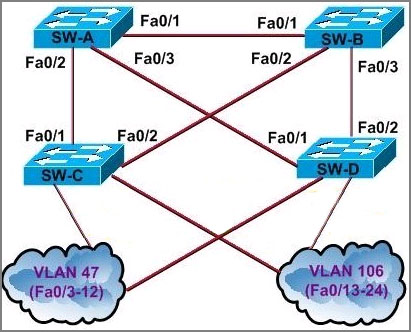
SpanningTreeBCMSNHotspot

The output of “show spanning-tree” command on SW-C:
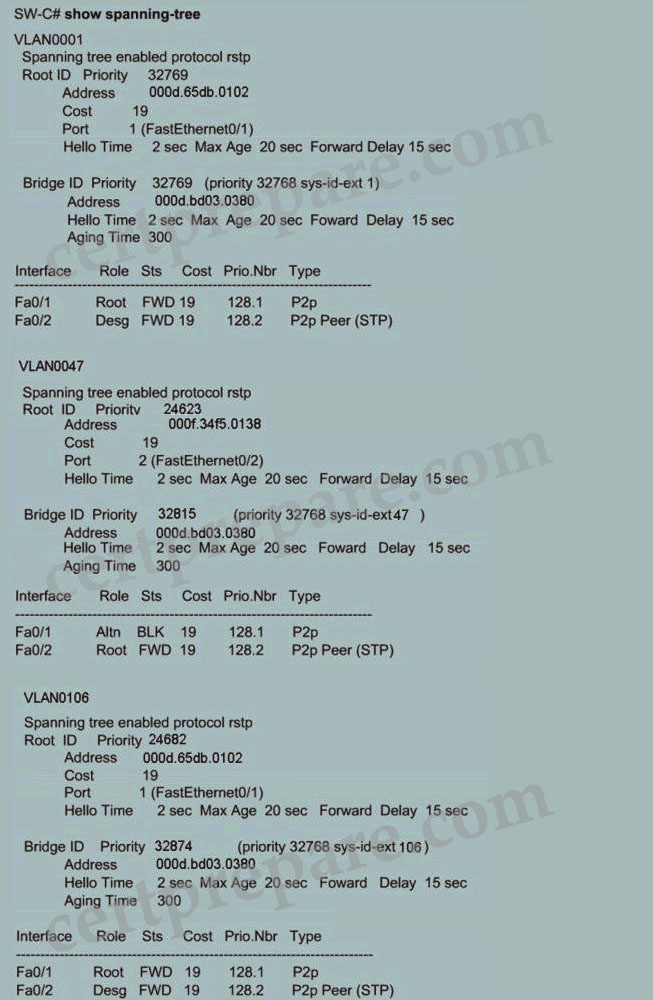
SpanningTree_show_spanning_tree


Question 1:

Which spanning Tree Protocol has been implemented on SW-B?

A. STP/IEEE 802.1D
B. MSTP/IEEE 802.1s
C. PVST+
D. PVRST
E. None of the above


Answer: C

Explanation:

On the Fa0/2 interface we can see the type of connection is P2p Peer (STP) and Cisco says that: “!— Type P2p Peer(STP) represents that the neighbor switch runs PVST.” Please visit this link to understand more http://www.cisco.com/en/US/products/hw/switches/ps708/products_configuration_example09186a00807b0670.shtml

Question 2:

Which bridge ID belongs to SW-B?

A. 24623.000f.34f5.0138
B. 32768.000d.bd03.0380
C. 32768.000d.65db.0102
D. 32769.000d.65db.0102
E. 32874.000d.db03.0380
F. 32815.000d.db03.0380


Answer: A

Explanation:

Have a look at the output at VLAN0047:
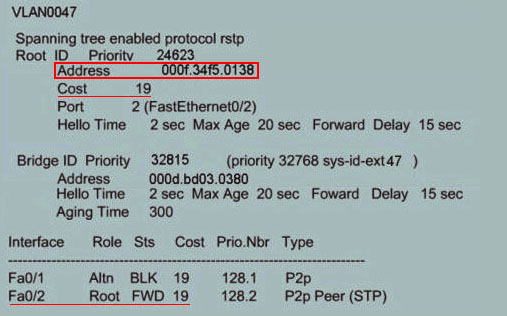
SpanningTree_show_spanning_tree_VLAN47

Notice there are two “Cost” value in the picture, the above “Cost” is the total cost from the current switch to the root bridge while the second “Cost” refers to the cost on that interface (Fa0/2). Both these “Cost” are the same so we can deduce that the root bridge is connectly directly to this switch on Fa0/2 interface -> the root bridge is Switch B, and the “Address” field shows its MAC address 000f.34f5.0138. Notice Bridge ID = Bridge Priority + MAC address.

Question 3:

Which port role has interface Fa0/2 of SW-A adopted for VLAN 47?

A. Root port
B. Nondesigned port
C. Designated port
D. Backup port
E. Alternate port


Answer: C

Explanation:

We learned that Switch B is the root bridge for VLAN 47 so port Fa0/1 on SwitchA and Fa0/2 on SwitchC should be the root ports, and from the output of SwitchC, we knew that port Fa0/1 of SwitchC is in blocking state. Therefore its opposite port on SwitchA must be in designated state (forwarding).

So, can Fa0/2 of SW-A be in blocking state? The answer is no so that BPDU packets can be received on Fa0/1 of SW-C. It will remain in blocking state as long as a steady flow of BPDUs is received.

Question 4:

Which port state is interface Fa0/2 of SW-B in for VLANs 1 and 106?

A. Listening
B. Learning
C. Disabled
D. Blocking
E. Forwarding
F. Discarding


Answer: D

Explanation:

As explained in question 2, we can deduce SW-A is the root bridge for VLANs 1 and 106 so ports Fa0/1 on SW-B and SW-C will be the root ports. From the output of SW-C for VLANs 1 and 106, port Fa0/2 of this switch is designated (forwarding) so we can deduce interface Fa0/2 of SW-B is in blocking status.

Question 5:

Which bridge ID belongs to SW-A?

A. 24623.000f.34f5.0138
B. 32768.000d.bd03.0380
C. 32768.000d.65db.0102
D. 32769.000d.65db.0102
E. 32874.000d.db03.0380
F. 32815.000d.db03.0380


Answer: D

Explanation:

SW-A is the root bridge for VLANs 1 and 106 and we can easily find the MAC address of this root bridge from the output of SW-C, it is 000d.65db.0102. Notice that SW-A has 2 bridge IDs for VLANs 1 and 106, they are 32769.000d.65db.0102 and 24682.000d.65db.0102

Comments
  1. Anon
    August 16th, 2010

    I assume this is labeled wrong? STP hotspot maybe?

  2. certprepare
    August 18th, 2010

    Yes, thanks for your detection. I updated this page.

  3. DONG
    August 22nd, 2010

    I think that in the explanation of question 3:…Fa0/1 on SwitchA and Fa0/2 on SwitchC should be the root ports…(switchC not switchB because Fa0/2 on switchB will be desg FWD )

  4. certprepare
    August 23rd, 2010

    Yes, thanks for your detection. I updated it!

  5. DONG
    August 23rd, 2010

    Ok, thanks for you too!

  6. Msxy
    August 29th, 2010

    please specify bridge id or root id ? thks

  7. ping9
    September 22nd, 2010

    has this ever come up in the exam?

  8. ANTIVIRUS
    October 11th, 2010

    herp derp

  9. brightm
    October 12th, 2010

    The answer to Question 1 doesn’t look right. From the command “show spanning-tree” on Switch C, interface fa0/2 connects to switch B and has a type of “P2p peer (STP)”

    According to Cisco press this means the neighbour (Switch B) is running 802.1D STP

    Excerpt:

    In addition, this output displays all the active ports participating in the VLAN 171 instance
    of RSTP, along with their port types. The string P2p denotes a point-to-point RSTP
    port type in which a full-duplex link connects two neighboring switches that both are
    running RSTP. If you see P2p Peer(STP), the port is a point-to-point type but the neighboring
    device is running traditional 802.1D STP.

  10. bdaboy22
    October 12th, 2010

    I have a query about question 3.
    The question is asking about the “port state” of a RSTP topology. I would say that the answer should be “discarding” as RSTP does not have a “blocking” state (doing the basic same thing but since 802.1w, the states and roles changed.
    http://www.cisco.com/en/US/tech/tk389/tk621/technologies_white_paper09186a0080094cfa.shtml#topic2

  11. bdaboy22
    October 12th, 2010

    Above comment is about question 4, NOT QUESTION 3!!!

  12. Lulavinyl
    October 13th, 2010

    @brightm
    @Certprepare

    You are right man. I looked it up on my Switch book.

    The right aswer is: STP/IEEE 802.1D

  13. Lulavinyl
    October 13th, 2010

    @Certprepare
    @bdaboy22

    You are right man.

    RSTP Port Roles:
    - Root Port
    - Designated Port
    - Alternate Port
    - Backup Port

    RSTP Port States:
    - Discarding
    - Learning
    - Forwarding

    The question asks us about the port state, so discarding state is the right answer.

    CCNP Switch book, page number 196: RSTP Port Behavior.

  14. vasanth.ios
    October 14th, 2010

    hi.. please can any one help me.. i need dumps for 642-813 exam.. if u know plz update..

  15. Peener
    October 20th, 2010

    Actually, the port would be in blocking, not discarding. Remember, from the show output, that switch B is running PVST not RSTP…so it is blocking, not discarding

  16. avast free download
    October 23rd, 2010

    have you ever tried avast antivirus before?

  17. Anonymous
    October 23rd, 2010

    Actually, its running PVST+, which as i understand it, is RSTP for multiple VLANS. so its discarding

  18. Peener
    October 25th, 2010

    PVRST+ would be discarding; you’re confusing that with PVST+, which converges similar to 802.1D (that’s from Cisco’s documentation). PVST+ still blocks. Lab it up, you’ll see what I mean.

  19. Anonymous
    October 31st, 2010

    Apologies Peener, i misunderstood the topology.

    SwB is running standard STP (or CST, Common spanning tree). its port role will be blocking.
    PVST+ is stp that supports both CST and PVST.

    confirmed in lab. With RSTP, the port status still shows as BLK, even though technicaly is is discarding, as can be seen for VLAN47 above.

    Please correct me if im wrong

  20. gbulan
    October 31st, 2010

    Dear All,
    I want to comment on Q1. From my point of view the answer should be PVST+ as given.
    “In PVST+, one spanning tree instance is created and used for each
    active VLAN that is defined on the switch. Each STP instance behaves according to the
    traditional 802.1D STP rules.” (ref: 642-813 offical cerfication guide, page 203)
    In this question, one instance of STP is used for each active VLAN in the network and that means PVST+ is running on this switch. The point that makes you confused about is each STP instance behaves based on 802.1D STP.

    Shortly, PVST+ —> each instance : Traditional 802.1D STP (P2P Peer (STP))
    Rapid PVST+ —> each instance: RSTP (P2P)

  21. gbulan
    October 31st, 2010

    Switch-C is in RPVST+ mode, the switch begin supporting both RSTP and 802.1D STP neighbors and you can see the neighbor type in the output of the show spanningtree vlan vlan-id command.

    Rapid PVST+ : “Spanning tree enabled protocol rstp” (SW-C)

  22. gbulan
    October 31st, 2010

    Comment for Q4:
    SW-B is in PVST+ mode and each instance is traditional 802.1D STP, so you need to recall five possible states:
    ■ Disabled
    ■ Blocking
    ■ Listening
    ■ Learning
    ■ Forwarding

    for Rapid PVST+ mode – each instance is RSTP, you need to recall three possible states:
    ■ Discarding – (This state combines the 802.1D Disabled, Blocking, and Listening states)
    ■ Learning
    ■ Forwarding

    In this question, obviously after this explanation the answer is “blocking state” due to SW-B is running PVST+, and 802.1D STP for each instance.

  23. Anonymous
    November 16th, 2010

    Can anyone explain me the answer for 2nd question MAC addr for switch B please..

  24. mr.xiao
    November 16th, 2010

    Q4,the answer is “blk”.
    Because , switchB is running STP, not RSTP.

  25. lcpteck
    November 17th, 2010

    @mr.xiao
    Sorry I don’t get your answer, please explain, thanks.

    Also, as per Question 1′s answer, Switch B is running PVST.

  26. lcpteck
    November 17th, 2010

    Regarding the types in ‘show spanning-tree’ output, found the following reference:

    http://www.networkstuff.eu/index.php/Spanning_Tree_Port_Types

  27. lcpteck
    November 17th, 2010

    Ah ok Switch bt is running STP, but running in PVST flavour since it’s all cisco heh…

  28. Anonymous
    November 22nd, 2010

    Can anyone please tell me if there is sufficient time to answer the questions? Do you have to rush? I’m asking this because at the routing exam i finished having more than one hour left
    Thanks

  29. KinZero
    December 17th, 2010

    For question #2, it asks Which bridge ID belongs to SW-B?
    The explanation should be cleared up to make it easier to understand.

    The explanation currently says, “Notice there are two “Cost” value in the picture, the above “Cost” is the total cost from the current switch to the root bridge while the second “Cost” refers to the cost on that interface (Fa0/2). Both these “Cost” are the same so we can deduce that the root bridge is connectly directly to this switch on Fa0/2 interface -> the root bridge is Switch B, and the “Address” field shows its MAC address 000f.34f5.0138. Notice Bridge ID = Bridge Priority + MAC address.”

    I think it should read something along the lines of:

    _______________________________________________________________
    Examine Switch C’s output. Notice their are two “costs” value’s under each VLAN. In each VLAN, both costs are equal (19 and 19) The first cost is the “root path cost” (cumulative cost of all links leading from the current switch to the root bridge). The second cost is the “path cost” (the cost of ONLY the next link in a path) . Whenever a root path cost = the path cost, it is safe to assume the root bridge is directly attached.

    Examine the topology and see that SW-C is connected to SW-B from its Fa0/2 interface. Now, revisit the config, and notice that the only VLAN Spanning-Tree that has SW-B’s Fa0/2 status as “root” is in VLAN 47. The root port always points towards the root bridge. Since we’ve already determined that both costs are equal, this means the root bridge is directly connected. When we look at the output for VLAN 47 we see:

    Root ID Priority 24623
    Address of 000f.34f5.0138.

    Remember that Bridge ID = Bridge Priority + MAC address, therefor the Bridge ID of SW-B = 24623+000f.34f5.0138 or 24623.000f.34f5.0138.
    ____________________________________________________________

    It took me quite awhile and lots of looking back at Cisco Press certification guide to figure out exactly how to get to the correct answer on this one, so hopefully this will help others.

  30. kalyan
    January 17th, 2011

    !— Type P2p Peer(STP) represents that the neighbor switch runs PVST.

  31. Yeahman
    January 29th, 2011

    @ping9… I took the bcmsn, and this was on the exam, can’t say for 813

  32. Monex
    February 24th, 2011

    shows a network containing three LAN segments separated by three bridges. shows the result of enabling STP on the bridges in the configuration.

  33. Bimbo
    March 1st, 2011
  34. Bimbo
    March 1st, 2011
  35. CMD
    March 3rd, 2011

    @all
    anybody got this hotspot?

  36. weareborg
    March 7th, 2011

    did anyone get this question in the exam recently?

  37. offshore corporations
    March 28th, 2011

    Protocol networklerde loop a neden olabilecek portlari block duruma alarak calisir.Her hedefe sadece bir yolun aktif olarak calismasini saglar.Spanning-Tree anlatiminda bircok kaynakta switchleri kavram olarak bridge olarak gorebilirsiniz..Sekildeki yapida switchler kendilerine gelen ve hedef adresi bilinmeyen paketleri diger tum portlarindan flood edeceklerdir.Cat 1 ve Cat 2 swtichleri 1 1 portlarina gelen frameleri flood edecek ve ayni frameleri portlarindan alacaklardir portundan aldigi bu frame leri 1 1 portlarindan flood edecek yine diger portlardan alacak bu boyle durmadan devam edecek..Durmadan devam etmekten kasit Switchler in cpu degerleri zamanla artacak ve bir sure sonra hizmet veremeyecek duruma geleceklerdir.Peki neden belirli bir sure sonra durmuyor ?.Bu sorunun cevabi cok acik Ethernet frameleri TTL Time to live alanina sahip degiller. Bu soz stp den konusurken hic unutulmamasi gereken bir soz olmalidir.O halde bunu biraz acmakta yarar var..Broadcast Multicast Unicast ve cok sik duymadigimiz Anycast bu kavramlari bir cogumuz biliyoruz ancak bilmeyen okuyucularimizinda olabilecegini dusunurek bu kavramlari izah edecegim..Broadcast genel anlamiyla yayin yapmak olarak kullanilir..Mesela siz bir topluluga girdiniz ve bir konu hakkinda bagira cagira konusuyorsunuz sizin konustugunuz konuyla hic ilgilenmeyen insanlarda bunu duyuyorlar iste bu broadcasttir..Ayni topluluktasiniz ve yine konustuklarinizi bir cok kisi duyuyor fakat bunlarin hepsi sizin anlattiginiz konuyla ilgiliyse bu durum Multicasttir..Toplulukta sadece tek bir kisiye ozel yalnizca onunla konusuyorsunuz.Bu durumda Unicasttir..Broadcast adresi switchler icin FFFF FFFF FFFF FFFF dir.Switchler broadcast gecirirler ve kendilerine gelen broadcastleri butun portlarina gonderirler…Sekilde Host A nin bir Arp requestte bulundugunu varsayalim Host B ye veri gonderecek ama Mac Adress-Table inda Mac adresi yok bu yuzden arp request gonderiyor.Arp request frameleri broadcast calisirlar.Dolayisiyla bu frame leri alan her 2 switch de bu frame leri butun portlarindan ileteceklerdir.1 numarali portlar ortadaki Hub vasitasiyla birbirlerine bagli yani burada bir yol var ayni zamanda Switch ler bu yapida A diye isimlendirilmis portlardanda bagli yani buradada bir yol var toplam 2 yol var .Switchler 1 portlarindan ve A isimli portlardan broadcastleri yayinlayacaklar ve farkli portlarindan yeniden alacaklar e dongu loop baslayacak.Bu durum Broadcast Storm olarak bilinir..Stp network de bir referans noktasi olusturur ve bu referans noktasindan hareketle eger yukaridaki yapidaki gibi birden fazla yol varsa en iyi yol secimini yapar.Bu referans noktasina Root Bridge denir..Spanning-Tree icerisinde Root Bridge Root Switch sistemi yoneten bridge dir.Butun switchler networke ilk dahil olduklarinda kendilerini root bridge olarak gorurler .Switchler haberlesme icin birbirlerine Bpdu adi verilen paketler gonderirler.Networke ilk dahil olduklarinda da Bpdu Bridge Protocol Data Unit paketi icerisindeki Root Id kismina kendi Bridge id lerini yazarlar..Ortamdaki en kucuk Bridge id ye sahip bridge Root Bridge dir…

  38. Rocket89
    April 11th, 2011

    This lab was in my exam at 7/April/2011 with 6Q …..only one Q was outside this Hotspot but the rest were from this hotspot as in this site

  39. Pavol
    April 19th, 2011

    how I see it :)

    ####################################
    Question 1:
    Which spanning Tree Protocol has been implemented on SW-B?
    Answer:
    A. STP/IEEE 802.1D
    Explanation:
    P2p Peer(STP) – If you see P2p Peer(STP), the port is a point-to-point type but the neighboring device is running traditional 802.1D STP
    ####################################
    Question 2:
    Which bridge ID belongs to SW-B?
    Answer:
    A. 24623.000f.34f5.0138
    Explanation:
    Check ID Priority and MAC on port Fa0/2 towards switch-B. Bridge ID = Bridge Priority + MAC address
    ####################################
    Question 3:
    Which port role has interface Fa0/2 of SW-A adopted for VLAN 47?
    Answer:
    C. Designated port
    Explanation:
    switch-A is running RSTP. if you see “P2p” – The string P2p denotes a point-to-point RSTP port type in which a full-duplex link connects two neighboring switches that both are running RSTP.
    RSTP Port Roles: Root, Designaded, Alternate, Backup
    RSTP Port Status: Discarding, Learning, Forwarding
    Discarding (This state combines the 802.1D Disabled, Blocking, and Listening states)
    Port Fa0/1 on switch-C is Role Altn Status BLK for vlan 47 to prevent loops.
    Port Fa0/2 on switch-A is Designated port as port Fa0/1 on this switch-A is root port for vlan 47.
    ####################################
    Question 4:
    Which port state is interface Fa0/2 of SW-B in for VLANs 1 and 106?
    Answer:
    D. Blocking
    Explanation:
    Switch-B running STP, not RSTP. Port Fa0/2 on switch-C is Designated for vlans 106 and 1.
    Switch-A is root for vlans 106 and 1.
    Port Fa0/1 on switch-B for vlans 106 and 1 is Root, so port Fa0/2 on this switch has to be BLK to prevent loops.
    ####################################
    Question 5:
    Which bridge ID belongs to SW-A?
    Answer:
    D. 32769.000d.65db.0102
    Explanation:
    switch-A is root for vlans 106 and 1.
    Root ID Priority for vlan 1: 32769
    Root ID Priority for vlan 106: 24692
    Mac Address for vlans 106 and 1 from switch-A is the same: 000d.65db.0102
    Bridge ID = Bridge Priority + MAC address
    Options (C. 32768.000d.65db.0102 or D. 32769.000d.65db.0102)
    Answer C is not correct.
    ####################################

  40. foo
    April 20th, 2011

    hi there,

    can you post or recall the 6th question which is not included here?

  41. butt
    April 21st, 2011

    hello rocket 89

    how did you do your hotspot questions. did you get one hotspot or two hotspot questions in your exam.
    how did you recognize that this is hotspot question. and after doing your first question did you enter next button or select 2 question option and then 3 and then 4 question. is it just like CCNA vtp hotspot or not.
    reply me please early as after three days i am going to take my exam.
    guide me properly with tricks and tips.
    please .

  42. Anonymous
    April 26th, 2011

    For Question 1, Spanning-tree Protocol Implemented on SW-B, answer is

    A. STP/IEEE 802.1D

    Page 204 of CCNP Switch Official Certification Guide:
    “The string P2p denotes a point-to-point RSTP port type in which a full-duplex link connects two neighboring switches that both are running RSTP. If you see P2p Peer(STP), the port is a point-to-point type but the neighboring device is running traditional 802.1D STP.”

  43. blue
    April 28th, 2011

    i thought this question will never appear in our real exam, right? some1 can advice on this?

  44. JEP
    May 2nd, 2011

    about question 1,

    default Bridge priority is 32768. for STP, BID = BP.MAC-Address
    for Per Vlan STP (PVST), BID = (BP+VLAN ID).MAC-Address

    notice that, command “spanning-tree vlan root primary” might be issued on SW-B for vlan 47. This will reduce Bridge priority (by two times of 4096). So, now bridge priority for vlan 47 on SW-B becomes 24576. Because this Switch run PVST the overall BID would be (24576+47).000f.34f5.0138 or 24623.000f.34f5.0138

    So SW-B running PVST+

  45. Pavol
    May 2nd, 2011

    hi foo,
    Queastion 6:
    DSW1 (150-1=149)
    DSW2 (200-55=145)
    149>145 => DSW1 became active
    Answer C is correct
    DSW1 (150-6=144)
    DSW2 (200-55=145)
    144 DSW2 stay active

  46. Pavol
    May 2nd, 2011

    hi foo,
    Queastion 6:
    DSW1 (150-1=149)
    DSW2 (200-55=145)
    149>145 => DSW1 became active
    Answer C is correct
    DSW1 (150-6=144)
    DSW2 (200-55=145)
    144<145 DSW2 stay active

  47. Derz
    May 10th, 2011

    @ Pavol

    Please state the head of the question as this’s the answer only.Thanks :)

  48. Abdeslam
    May 26th, 2011

    Q1: I remember this question (or somethings like this)

    Switch is raccordin to hub bye LInk A en port A
    When the second link B is added betwen switch and hub (all switch port A and b are configured to bpduguard )
    switchport A are on err-disable .
    one or two switchpor are on err-disable ?
    one or two switch port are forwardin ?

    what ‘s the answer fo this question ..

    Thank’s

  49. Anonymous
    May 31st, 2011

    The answer for Q1 is PVST check this link: http://www.cisco.com/en/US/products/hw/switches/ps708/products_configuration_example09186a00807b0670.shtml

    !— Type P2p Peer(STP) represents that the neighbor switch runs PVST.

  50. Erick Cruz
    May 31st, 2011

    The answer for Q1 is PVST check this link: http://www.cisco.com/en/US/products/hw/switches/ps708/products_configuration_example09186a00807b0670.shtml

    !— Type P2p Peer(STP) represents that the neighbor switch runs PVST.

  51. Karen
    June 17th, 2011

    Are the answers to this question correct now.
    Thanks for your help

  52. fschris
    June 23rd, 2011

    abdeslam…

    the bpdu will block a port or and the processor usage will go high

  53. Oliver
    June 30th, 2011

    Its definitely PVST+, don’t listen to these other wannabe experts, the bare fact that has different port states for different vlans concludes it must have more than one STP instance, how on earth would this be possible otherwise in one STP instance?

    If you’ve got an answer to this question please keep it to yourself or alternatively contact Cisco and they could include your statement as a ‘wrong’ answer.

  54. surulimanikandan
    July 3rd, 2011

    its very useful

    please add mote question………

  55. Keisha
    July 6th, 2011

    THX that’s a great awnser!

  56. Delores
    July 9th, 2011

    AFAICT you’ve covered all the bases with this ansewr!

  57. Unlearn
    July 20th, 2011

    Its definitely PVST+, its running multiple spanning tree + Its on cisco + Its trunking with RPVST.
    PVST only supports ISL, :D

  58. Fad
    September 11th, 2011

    guys, i’ve studied Jeremies videos & preparing for the exam, i need ur advice on which dumps shld i go with. your reply is highly appreciated. – ( I’m Lost ! :D )
    Thanks.

  59. francis
    September 11th, 2011

    http://www.cisco.com/en/US/products/hw/switches/ps708/products_configuration_example09186a00807b0670.shtml

    !— Type P2p Peer(STP) represents that the neighbor switch runs PVST.

    Be giuded accordingly

  60. Kayden
    September 19th, 2011

    whats the difference btw root ID and bridge ID?

  61. amira
    September 25th, 2011

    question 2:
    i tried it on packet tracer :
    the both values cost represented the interface cost …
    @certprepare
    simply we can deduce the same answer by excluding the others

  62. kirk
    October 2nd, 2011

    Hi on question 1 I cant understand wat the clouds are. are those vlans in switch C or are those another switch?

  63. Anonymous
    October 20th, 2011

    this hotspot is still in the actuall right? or the HSRP hotspot?

  64. basta63
    October 27th, 2011

    Q1 – imho the answer is not right! The true answer is A (STP 802.1D)

    From official certification guide: page 204
    ” In addition, this output displays all the active ports participating in the VLAN 171 instance
    of RSTP, along with their port types. The string P2p denotes a point-to-point RSTP
    port type in which a full-duplex link connects two neighboring switches that both are
    running RSTP. If you see P2p Peer(STP), the port is a point-to-point type but the neighboring
    device is running traditional 802.1D STP.”

  65. EDG
    October 27th, 2011

    basta63,
    the answer to Q1 would be correct. PVST+ is based on 802.1D STP which is the traditional STP. The difference between PVST+ and 802.1D is that PVST+ runs on several VLANs whereas 802.1D runs on one only.

    PVST+ runs 802.1D on several VLANs, so this answer is correct for PVST+ because according to the output shown SW B is running several VLAN (802.1D PVST+) instances not one (802.1D)

  66. math1a5
    November 5th, 2011

    @EDG Precisely. I can confirm that Q1 answer is correct. I’ve just tried it with an old switch connected to 3750, traditional STP (802.1D) appears as P2P Peer(STP) on one VLAN only.

  67. Sanjith
    November 6th, 2011

    !— Type P2p Peer(STP) represents that the neighbor switch runs PVST.

    http://www.cisco.com/en/US/products/hw/switches/ps708/products_configuration_example09186a00807b0670.shtml

  68. Ahmed
    November 16th, 2011

    how can SW B be configured with tr. STP and have multiple vlan instances ??

  69. firas
    November 22nd, 2011

    are this quastion come on exam
    ?????

  70. Gardener
    November 25th, 2011

    firas . Yes.

  71. Venkatachalam.T
    November 28th, 2011

    Dear friends,

    I want wright exam (642-813) next week, pls any one send latest dumps,

    My id :venkatraj030@gmail.com,

    regards,
    venkat.

  72. Zaheer
    November 29th, 2011

    Friends,
    I have planned to write my Switching Exam on 3rd December.
    Kindly provide me the latest dumps if possible.

    MAIL ID: mail2zaheer@gmail.com

    Thanks & Regards,
    Zaheer Ahmed S

  73. vikki
    December 3rd, 2011

    hey zaheer hv u got cleard ur exam?

    please tell us about exam questions.
    next week m writing exam

  74. vikki
    December 4th, 2011

    hey i want to speak about Q1
    answer shud be A
    stp

    please check and change it

  75. jingli
    December 5th, 2011

    hi everyone,are the dumps change much?i also want to take it,but for me is a little diffcult,any advice is welcome

  76. jingli
    December 5th, 2011

    and my id :laijingli2006@126.com a chinese ccnper.

  77. rk
    December 10th, 2011

    Hey frnds,

    planning to write switch exam in the last week of DEC. will really appreciate if someone can share latest dumps and share some suggestions to my Email:ran4u@inbox.com

    Thanks in Advance
    RK

  78. jagrenet
    December 10th, 2011

    This was on the 813 exam as of 12/08/11

  79. jagrenet
    December 10th, 2011

    An added FYI -

    All of the Labs SIMS Listed on CertPrepare are still valid as of 12/08/11. On my test I saw the ….

    AAAdot1x
    LACP with STP
    HSRP Hotspot
    VTP2
    MLS with EIGRP

    ALL OF THESE SIMS/LABS WERE ON MY TEST PEOPLE – KNOW THEM WELL !!!!!!!
    (all can be found here on certprepare)

  80. vinit
    December 24th, 2011

    hi on 21st i gave exam i passed it with 934 score.
    hey guys earlier i was nervous but when u saw the 1st q in my exam, i smiled.
    qs were easy dont need to hesitate.
    i had finished my exam within 1 Hr.

    for any help regarding dumps or query can contact me at vindude5@gmail.com

    ALL tHE Best to all PEOPLE FOR Christmas & 2012.

  81. vinit
    December 24th, 2011

    i didnt get any ques from this part
    But it doesnt mean u wont .

  82. Anonymous
    January 19th, 2012

    There is difference in the answers of vc file and p4s dumps… i m so tens,,, my concepts are so weak…
    please tell me on which ones should me prepare????
    please reply fast i have exam after 12 hour

  83. Indu
    January 25th, 2012

    Which three statements about STP timers are true? (Choose three.)
    A. STP timers values (hello, forward delay, max age) are included in each BPDU.
    B. A switch is not concerned about its local configuration of the STP timers values. It will only consider the value of the STP timers contained in the BPDU it is receiving.
    C. To successfully exchange BPDUs between two switches, their STP timers value (hello, forward delay, max age) must be the same.
    D. If any STP timer value (hello, forward delay, max age) needs to be changed, it should at least be changed on the root bridge and backup root bridge.
    E. On a switched network with a small network diameter, the STP hello timer can be tuned to a lower value to decrease the load on the switch CPU.
    F. The root bridge passes the timer information in BPDUs to all routers in the Layer 3 configuration.
    Answer: ABD

    Can some body Explain me the answers :)

  84. Bob
    January 27th, 2012

    Hi, Great site
    Correction to question 1
    answer is protocol ieee , which is STP/IEEE 802.1D ?

    I have labed this up on 2 x 3560′s as below
    Lets use vlan 1

    Rack1SW1#sh spanning-tree vlan 1

    VLAN0001
    Spanning tree enabled protocol ieee (SPANNING TREE)
    Root ID Priority 32769
    Address 001d.e51a.1e80
    This bridge is the root
    Hello Time 2 sec Max Age 20 sec Forward Delay 15 sec

    Bridge ID Priority 32769 (priority 32768 sys-id-ext 1)
    Address 001d.e51a.1e80
    Hello Time 2 sec Max Age 20 sec Forward Delay 15 sec
    Aging Time 300

    Interface Role Sts Cost Prio.Nbr Type
    ——————- —- — ——— ——– ——————————–
    Fa0/13 Desg FWD 19 128.15 P2p
    Fa0/15 Desg FWD 19 128.17 P2p
    Fa0/21 Desg FWD 19 128.23 P2p —-> this port faces Rack1SW4 , so lets check this switch

    Rack1SW4#sh spanning-tree vlan 1

    VLAN0001
    Spanning tree enabled protocol rstp
    Root ID Priority 32769
    Address 001d.e51a.1e80
    Cost 19
    Port 17 (FastEthernet0/15)
    Hello Time 2 sec Max Age 20 sec Forward Delay 15 sec

    Bridge ID Priority 32769 (priority 32768 sys-id-ext 1)
    Address 0025.83f4.7c80
    Hello Time 2 sec Max Age 20 sec Forward Delay 15 sec
    Aging Time 300

    Interface Role Sts Cost Prio.Nbr Type
    ——————- —- — ——— ——– ——————————–
    Fa0/15 Root FWD 19 128.17 P2p Peer(STP) —-These ports are all facing switches running Spanning tree enabled protocol ieee
    Fa0/19 Desg FWD 19 128.21 P2p Peer(STP)
    Fa0/20 Desg FWD 19 128.22 P2p Peer(STP)

    Any other ideas?

  85. Bob
    January 27th, 2012

    Correction….Ive done a bit more digging. It seems that a cisco switch will see a neigbor running in COMPATABLE mode as P2p Peer(STP). This is infact PVST+. So…again we are back with C being corret?

  86. Anonymous
    February 2nd, 2012

    “”Anonymous January 19th, 2012 There is difference in the answers of vc file and p4s dumps… i m so tens,,, my concepts are so weak…”"”

    Go back to the books and study hard, you doesnt deserve to be an CCNP!

  87. PVST question 1
    February 6th, 2012

    I would say C is correct based on this link from Cisco’s site.

    http://www.cisco.com/en/US/products/hw/switches/ps708/products_configuration_example09186a00807b0670.shtml

    CONCERNING TEXT FROM LINK BELOW

    Access1#show spanning-tree vlan 10

    VLAN0010
    Spanning tree enabled protocol rstp
    Root ID Priority 24586
    Address 0015.63f6.b700
    Cost 19
    Port 107 (FastEthernet3/0/1)
    Hello Time 2 sec Max Age 20 sec Forward Delay 15 sec

    Bridge ID Priority 32778 (priority 32768 sys-id-ext 10)
    Address 000f.f794.3d00
    Hello Time 2 sec Max Age 20 sec Forward Delay 15 sec
    Aging Time 300

    Interface Role Sts Cost Prio.Nbr Type
    —————- —- — ——— ——– ——————————–
    Fa3/0/1 Root FWD 19 128.107 P2p Peer(STP)
    Fa3/0/2 Altn BLK 19 128.108 P2p Peer(STP)

    !— Type P2p Peer(STP) represents that the neighbor switch runs PVST.

    ^^^^^^^^^^^^^^^^^^^^^^^^^^^^^^^^^^^^^^^^^^^^^^

  88. Auger3
    February 7th, 2012

    Based on the Cisco website link above, there is no doubt about Q1 answer. Cisco says,

    “Type P2p Peer(STP) represents that the neighbor switch runs PVST”

    So case closed!

  1. No trackbacks yet.
Add a Comment