
STP Questions
Here you will find answers to STP Questions
Question 1
Company uses MSTP within their switched LAN. What is the main purpose of Multiple Instance Spanning Tree Protocol (MSTP)?
A. To enhance Spanning Tree troubleshooting on multilayer switches
B. To reduce the total number of spanning tree instances necessary for a particular topology
C. To provide faster convergence when topology changes occur in a switched network
D. To provide protection for STP when a link is unidirectional and BPDUs are being sent but not received
Answer: B
Explanation
Instead of running an STP instance for every VLAN, MSTP runs a number of VLAN-independent STP instances. By allowing a single instance of STP to run for multiple VLANs, MSTP keeps the number of STP instances to minimum (saving switch resources) while optimizing Layer 2 switching environment (load balancing traffic to different paths for different VLANs.).
Question 2
Which of the following specifications will allow you to associate VLAN groups to STP instances so you can provide multiple forwarding paths for data traffic and enable load balancing?
A. IEEE 802.1d (STP)
B. IEEE 802.1s (MST)
C. IEEE 802.1q (CST)
D. IEEE 802.1w (RSTP)
Answer: B
Question 3
Refer to the exhibit. All network links are FastEthernet. Although there is complete connectivity throughout the network, Front Line users have been complaining that they experience slower network performance when accessing the Server Farm than the Reception office experiences. Based on the exhibit, which two statements are true? (Choose two)
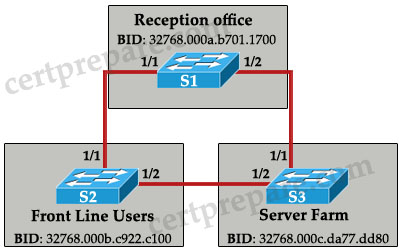
A. Changing the bridge priority of S1 to 4096 would improve network performance.
B. Changing the bridge priority of S1 to 36864 would improve network performance.
C. Changing the bridge priority of S2 to 36864 would improve network performance.
D. Changing the bridge priority of S3 to 4096 would improve network performance.
E. Disabling the Spanning Tree Protocol would improve network performance.
F. Upgrading the link between S2 and S3 to Gigabit Ethernet would improve performance.
Answer: B D
Explanation
All three switches have the same bridge priority (32768 – default value) and S1 has the lowest MAC -> S1 is the root bridge and all traffic must go through it -> Front Line Users (S2) must go through S1 to reach Server Farm (S3). To overcome this problem, S2 or S3 should become the root switch and we can do it by changing the bridge priority of S1 to a higher value (which lower its priority – answer B) or lower the bridge priority value (which higher its priority – answer D)
Question 4
Refer to the exhibit. Initially, LinkA is connected and forwarding traffic. A new LinkB is then attached between SwitchA and HubA. Which two statements are true about the possible result of attaching the second link? (Choose two)
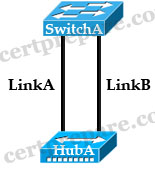
A. The switch port attached to LinkB will not transistion to up.
B. One of the two switch ports attached to the hub will go into blocking mode when a BPDU is received.
C. Both switch ports attached to the hub will transition to the blocking state.
D. A heavy traffic load could cause BPDU transmissions to be blocked and leave a switching loop.
E. The switch port attached to LinkA will immediately transition to the blocking state.
Answer: B D
Explanation
we know that there will have only one Designated port for each segment (notice that the two ports of SwitchA are on the same segment as they are connected to a hub). The other port will be in Blocking state. But how does SwitchA select its Designated and Blocking port? The decision process involves the following parameters inside the BPDU:
* Lowest path cost to the Root
* Lowest Sender Bridge ID (BID)
* Lowest Port ID
In this case, both interfaces of SwitchA have the same “path cost to the root” and “sender bridge ID” so the third parameter “lowest port ID” will be used. Suppose two interfaces of SwitchA are fa0/1 & fa0/2 then SwitchA will select fa0/1 as its Designated port (because fa0/1 is inferior to fa0/2) -> B is correct.
Suppose the port on LinkA (named portA) is in forwarding state and the port on LinkB (named portB) is in blocking state. In blocking state, port B still listens to the BPDUs. If the traffic passing through LinkA is too heavy and the BPDUs can not reach portB, portB will move to listening state (after 20 seconds for STP) then learning state (after 15 seconds) and forwarding state (after 15 seconds). At this time, both portA & portB are in forwarding state so a switching loop will occur -> D is correct.
Question 5
Refer to the exhibit. Switch S1 is running mst IEEE 802.1s. Switch S2 contains the default configuration running IEEE 802.1D. Switch S3 has had the command spanning-tree mode rapid-pvst running IEEE 802.1w. What will be the result?
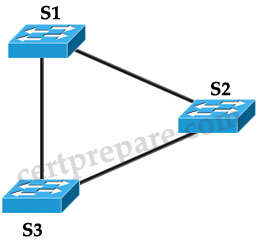
A. IEEE 802.1D and IEEE 802.1w are incompatible. All three switches must use the same standard or no traffic will pass between any of the switches.
B. Switches S1, S2, and S3 will be able to pass traffic between themselves.
C. Switches S1, S2, and S3 will be able to pass traffic between themselves. However, if there is a topology change, Switch S2 will not receive notification of the change.
D. Switches S1 and S3 will be able to exchange traffic but neither will be able to exchange traffic with Switch S2
Answer: B
Explanation
A switch running both MSTP and RSTP supports a built-in protocol migration mechanism that enables it to interoperate with legacy 802.1D switches. If this switch receives a legacy 802.1D configuration BPDU (a BPDU with the protocol version set to 0), it sends only 802.1D BPDUs on that port. An MST switch can also detect that a port is at the boundary of a region when it receives a legacy BPDU, an MST BPDU (version 3) associated with a different region, or an RST BPDU (version 2).
However, the switch does not automatically revert to the MSTP mode if it no longer receives 802.1D BPDUs because it cannot determine whether the legacy switch has been removed from the link unless the legacy switch is the designated switch
(Reference: http://www.cisco.com/en/US/docs/switches/lan/catalyst2950/software/release/12.1_9_ea1/configuration/guide/swmstp.html)
Question 6
Refer to the exhibit. Switch S2 contains the default configuration. Switches S1 and S3 both have had the command spanning-tree mode rapid-pvst issued on them. What will be the result?
A. IEEE 802.1D and IEEE 802.1w are incompatible. All three switches must use the same standard or no traffic will pass between any of the switches.
B. Switches S1, S2. and S3 will be able to pass traffic between themselves.
C. Switches S1, S2. and S3 will be able to pass traffic between themselves. However, if there is a topology change. Switch S2 will not receive notification of the change.
D. Switches S1 and S3 will be able to exchange traffic but neither will be able to exchange traffic with Switch S2.
Answer: B
Question 7
Which two statements are true when the extended system ID feature is enabled? (Choose two)
A. The BID is made up of the bridge priority value (2 bytes) and bridge MAC address (6 bytes).
B. The BID is made up of the bridge priority (4 bits), the system ID (12 bits), and a bridge MAC address (48 bits).
C. The BID is made up of the system ID (6 bytes) and bridge priority value (2 bytes).
D. The system ID value is the VLAN ID (VID).
E. The system ID value is a unique MAC address allocated from a pool of MAC addresses assigned to the switch or module.
F. The system ID value is a hex number used to measure the preference of a bridge in the spanning-tree algorithm.
Answer: B D
Explanation
In short, with the use of IEEE 802.1t spanning-tree extensions, some of the bits previously used for the switch priority are now used for the extended system ID
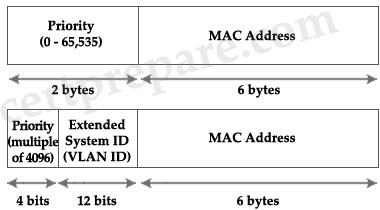
Only four high-order bits of the 16-bit Bridge Priority field carry actual priority. Therefore, priority can be incremented only in steps of 4096. In most cases, the Extended System ID holds the VLAN ID. For example, if our VLAN ID is 5 and we use the default bridge priority 32768 then the 16-bit Priority will be 32768 + 5 = 32773.
Note: The MAC address is reserved when the extended system ID feature is enabled.
Question 8
Which set of statements about Spanning Tree Protocol default timers is true?
A.
The hello time is 2 seconds.
The forward delay is 10 seconds.
The max_age timer is 15 seconds.
B.
The hello time is 2 seconds.
The forward delay is 15 seconds.
The max_age timer is 20 seconds.
C.
The hello time is 2 seconds.
The forward delay is 20 seconds.
The max_age timer is 30 seconds.
D.
The hello time is 5 seconds.
The forward delay is 10 seconds.
The max_age timer is 15 seconds.
E.
The hello time is 5 seconds.
The forward delay is 15 seconds.
The max_age timer is 20 seconds.
Answer: B
Explanation
There are several STP timers, as this list shows:
* Hello – The hello time is the time between each bridge protocol data unit (BPDU) that is sent on a port. This time is equal to 2 seconds (sec) by default, but you can tune the time to be between 1 and 10 sec.
* Forward delay – The forward delay is the time that is spent in the listening and learning state. This time is equal to 15 sec by default, but you can tune the time to be between 4 and 30 sec.
* Max age – The max age timer controls the maximum length of time that passes before a bridge port saves its configuration BPDU information. This time is 20 sec by default, but you can tune the time to be between 6 and 40 sec.
(Reference: http://www.cisco.com/en/US/tech/tk389/tk621/technologies_tech_note09186a0080094954.shtml)
Question 9
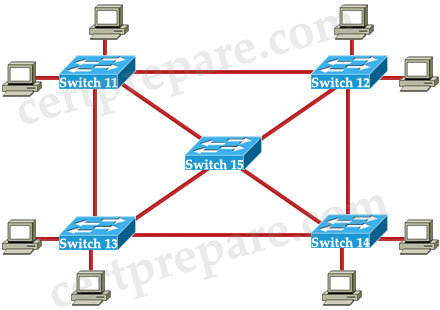
Refer to the exhibit. Switch 15 is configured as the root switch for VLAN 10 but not for VLAN 20. If the STP configuration is correct, what will be true about Switch 15?
A. All ports will be in forwarding mode.
B. All ports in VLAN 10 will be in forwarding mode.
C. All ports in VLAN 10 will be in forwarding mode and all ports in VLAN 20 will be in blocking mode.
D. All ports in VLAN 10 will be in forwarding mode and all ports in VLAN 20 will be in standby mode.
Answer: B
Explanation
All ports on root bridge are designated ports, which are in forwarding state but notice in this case Switch 15 is the root switch for VLAN 10 -> all ports in VLAN 10 will be in forwarding state. We can not say anything about the modes of ports of Switch 15 in other VLANs.
Question 10
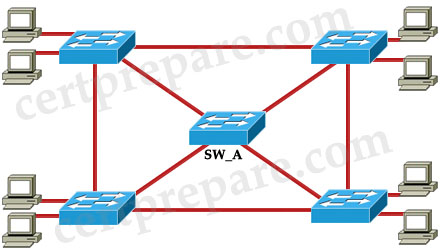
Refer to the exhibit. STP has been implemented in the network. Switch SW_A is the root switch for the default VLAN. To reduce the broadcast domain, the network administrator decides to split users on the network into VLAN 2 and VLAN 10. The administrator issues the command spanning-tree vlan 2 root primary on switch SW_A. What will happen as a result of this change?
A. All ports of the root switch SW_A will remain in forwarding mode throughout the reconvergence of the spanning tree domain.
B. Switch SW_A will change its spanning tree priority to become root for VLAN 2 only.
C. Switch SW_A will remain root for the default VLAN and will become root for VLAN 2.
D. No other switch in the network will be able to become root as long as switch SW_A is up and running.
Answer: C
Explanation
This command sets the switch to become root for a given VLAN. It works by lowering the priority of the switch until it becomes root. Once the switch is root, it will not prevent any other switch from becoming root. In particular, if the current root bridge is greater than 24576 then our switch will drop to 24576. If the current root bridge is less than 24576, our new bridge priority will be (Priority value of the current root bridge – 4096).
This command does not affect other VLAN so SW_A will remain root for the default VLAN -> C is correct.
Note: This command is not shown in a Catalyst switch configuration because the command is actually a macro executing other switch commands.