
Drag and Drop Questions
Here you will find answers to Drap and Drop questions
Question 1:
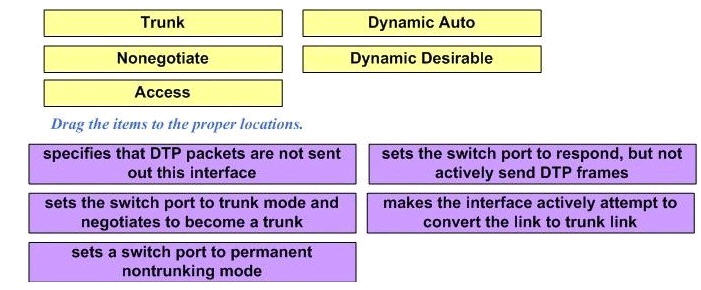
Place the DTP mode with its correct description:
Answer:
1) Trunk: Set the switch port to trunk mode and negotiate to become a trunk.
2) Nonegotiate: Specify that the DTP packets are not sent out of this interface.
3) Access: Set a switch port to permanent nontrunking mode.
4) Dynamic Auto: Set the switch port to respond, but not actively send DTP frames.
5) Dynamic Desirable: Make the interface actively attempt to convert the link to a trunk link. (This means the interface is ready to autonegotiate trunking encapsulation and form a trunk link (using DTP) with a neighbor port in desirable, auto, or on mode.)
Explanation:
Dynamic Trunking Protocol (DTP) is the Cisco-proprietary that actively attempts to negotiate a trunk link between two switches. Below is the switchport modes (or DTP modes) for easy reference:
| Mode | Function |
| Dynamic Auto | Creates the trunk based on the DTP request from the neighboring switch. |
| Dynamic Desirable | Communicates to the neighboring switch via DTP that the interface would like to become a trunk if the neighboring switch interface is able to become a trunk. |
| Trunk | Automatically enables trunking regardless of the state of the neighboring switch and regardless of any DTP requests sent from the neighboring switch. |
| Access | Trunking is not allowed on this port regardless of the state of the neighboring switch interface and regardless of any DTP requests sent from the neighboring switch. |
| Nonegotiate | Prevents the interface from generating DTP frames. This command can be used only when the interface switchport mode is access or trunk. You must manually configure the neighboring interface as a trunk interface to establish a trunk link. |
Question 2:
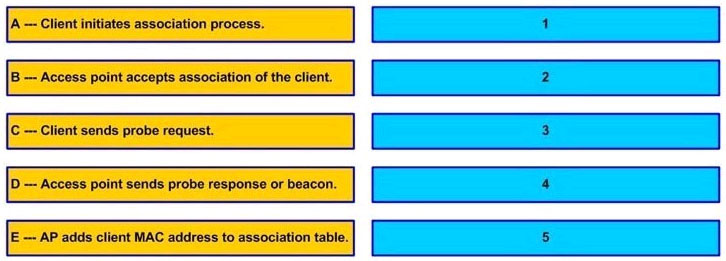
This is a drag and drop question which is about the correct sequence of steps that a wireless client takes during the process of association with an access point (AP). Drag the items to the proper locations.
Answer:
Explanation:
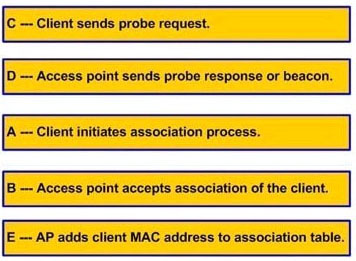
Any wireless client attempting to use the wireless network must first arrange a membership with the AP. Membership with the AP is called an association. The client must send an association request message, and the AP grants or denies the request by sending an association reply message. Once associated, all communications to and from the client must pass through the AP. Clients associate with access points as follows:
1) The client sends a probe request.
2) The AP sends a probe response.
3) The client initiates an association to an AP. Authentication and any other security information is sent to the AP.
4) The AP accepts the association.
5) The AP adds the client’s MAC address to its association table.
Question 3:
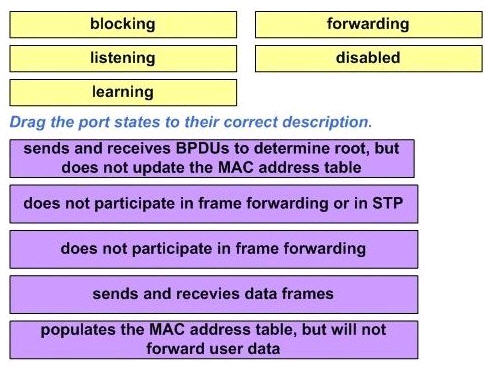
Drag and drop question. Drag the items to the proper locations.
Answer:
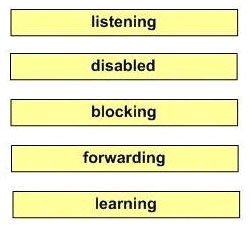
1) Listening: sends and receives BPDUs to determine root, but does not update the MAC address table.
2) Disabled: does not participate in frame forwarding or in STP.
3) Blocking: does not participate in frame forwarding.
4) Fowarding: sends and receives data frames.
5) Learning: populates the MAC address table, but will not forward user data.
Notice: A port begins its life in a Disabled state, moving through several passive states and, finally, into an active state if allowed to forward traffic.
Question 4 (not sure about the question)
network level – RSTP, NSF
system level – Dual power supply, SSO
management level – NTP , IP SLA
verify that the vlan is assigned to the proper ports
verify that creation of the virtual interface
Verify that there is inter-switch connectivity
verify that switchports are properly pruned
Number of IP Subnets
VLAN to IP mapping
Location of each VLAN
VLAN assignments

Passed 642-813 with 985/1000 score
2 D&D
3 SiM LACP, AAA, STP with EIGRP
The actual anser for QoS D&D is as follows ( i got 100% score in this part)
voice
video interactive
video streaming
call signaling
ip routing
network management
another D&D was of Dynamic desirable, nonegotiate, trunk , access
in STP with EIGRP you dont need to make switch port member of vlan 2 and 3 as they were already there. The answere were not in the same order as they are in P4s.
I prepared the exam with nuggets, David Hucaby Book on CCNP Switch and P4s. Just wana inform you that there are few questions in p4s whose answers are not correct. for that you need to study the book
Good luck to all those who will be going for Switching exam in Future
@Muj Congratulations for passing the exam
is it possible to share the questions (or their no from P4s) you think are wrong
thanks in advance
I took the CCNP switch exam last year and failed it. I will be retaking it on the 12th of May. Are questions repeated when you are retaking? Or am going to be expecting new questions? I need to know
up post:
“The correct solution to the drag & drop question regarding proper sequence a lightweight access point associates with a WLAN controller is:
1. The IP address is statically configured on the lightweigh AP.
2. The lightweight AP requests an IP address via DHCP
3. The lightweight AP searches for a wireless LAN controller using LWAPP in Layer 2 mode.
4. The lightweight AP sends a LWAPP Discovery Request to the management IP address of the wireless LAN controller via broadcast
5. The wireless LAN controller responds with a Discovery Response from the Manager IP address.
6. The lightweight AP chooses the AP Manager with the least number of associated access points and sends the join request.
source:
http://www.cisco.com/en/US/tech/tk722/tk809/technologies_tech_note09186a00806c9e51.shtml
does anyone confirm??????????”
@Lukasz
You’re right. On Passforsure its different?!
Passforsure is crap sometime! Should get my money back!
@ May
“The actual anser for QoS D&D is as follows ( i got 100% score in this part)
voice
video interactive
video streaming
call signaling
ip routing
network management”
in book David Hucaby CCNP SWITCH 642-813 Official Certification Guide, on page 317 (chapter 14 : IP Telephony) QoS topic says that ip routing has a higher priority (6 and 7) than voice traffic (priority 5).
whats proper order????????????????
@May
You are correct. IP routing has the highest priority.
The correct order is:
ip routing
voice
video interactive
video streaming
call signaling
network management
Reference: http://www.cisco.com/en/US/technologies/tk543/tk759/technologies_white_paper0900aecd80295a9b.pdf
Hello,
I think that this is the correct arrangement for the drag and drop question for LAP discovery process.
1. The lightweight AP requests an IP address via DHCP
2. The lightweight AP searches for a wireless LAN controller using LWAPP in Layer 2 mode.
3. The lightweight AP sends a LWAPP Discovery Request to the management IP address of the wireless LAN controller via broadcast
4. The wireless LAN controller responds with a Discovery Response from the Manager IP address.
5. The lightweight AP chooses the AP Manager with the least number of associated access points and sends the join request.
Note: The LAPs issue a DHCP discovery request to get an IP address, unless it has previously had a static IP address configured.
Please correct me if you feel this is wrong.
QoS Baseline Model:
Voice
Video Interactive
Video Streaming
Call Signaling
IP Routing
Network Management
…
Reference: http://www.cisco.com/en/US/technologies/tk543/tk759/technologies_white_paper0900aecd80295a9b.pdf
The first part where is list IP Routing first is only talking about the DSCP (which the table is sorted on), but Voice is considered more important.
*Clarified this with a CCIE here at work
The Cos situation seems to be true regarding the QoS baseline. However the question is to order based on priority. Based in Priority the IP routing should be the 1st. However if a colleague is saying that had 100% on that… I will trust him.
Regarding the drag and drop question for LAP discovery process: I also have doubts, because if we have the IP statically configured why are we send him the DHCP Request? Does not make sense !!! I hate this kind of tricky questions that does not prove anything regarding our knowledge !!!
I will be having the exame tomorrow, can anybody helpp ?!!??!?!?! Please !!! :)
ccnp switching i failed it and iam looking forward to retake it Are questions repeated when you are retaking? Or am going to be expecting new questions? I need to know
you can post to mutsetse@gmail.com
Hello,
I think that this is the correct arrangement for the drag and drop question for LAP discovery process.
1. The lightweight AP requests an IP address via DHCP
2. The lightweight AP searches for a wireless LAN controller using LWAPP in Layer 2 mode.
3. The lightweight AP sends a LWAPP Discovery Request to the management IP address of the wireless LAN controller via broadcast
4. The wireless LAN controller responds with a Discovery Response from the Manager IP address.
5. The lightweight AP chooses the AP Manager with the least number of associated access points and sends the join request.
Note: The LAPs issue a DHCP discovery request to get an IP address, unless it has previously had a static IP address configured.
Can anyone confirm the below sequence ? Anyone confident about the sequence. I am not sure for this question.
1. The IP address is statically configured on the lightweigh AP.
2. The lightweight AP requests an IP address via DHCP
3. The lightweight AP searches for a wireless LAN controller using LWAPP in Layer 2 mode.
4. The lightweight AP sends a LWAPP Discovery Request to the management IP address of the wireless LAN controller via broadcast
5. The wireless LAN controller responds with a Discovery Response from the Manager IP address.
6. The lightweight AP chooses the AP Manager with the least number of associated access points and sends the join request.
@ Harry:
As JP mentioned, AP does not need to request the IP address via DHCP if you have manually configured a static ip on the AP.
Note: The LAPs issue a DHCP discovery request to get an IP address, unless it has previously had a static IP address configured.
@ Ninja Spoon
You say: “The first part where is list IP Routing first is only talking about the DSCP (which the table is sorted on), but Voice is considered more important.”
Based on what criterion is voice more important than IP Routing (a.k.a. network control traffic)?
I was under the impression that the class of service, IP precedence or DSCP are the only criteria by which we prioritized the traffic types at layers 2-3 (we’ll leave aside for now, L4 ports, ACLs or NBAR).
Since Cisco presents two conflicting models on the very same page (see the PDF link in the last Ninja Spoon’s post) how the heck are we supposed to know what they want us to learn???
On the top of the page you see the traffic classes ordered by DSCP and IP precedence and then on the bottom of the page they slap the “baseline model” which turns the above list on its head, without bothering to explain what other criterion of classification they used.
dear all,
just to Clarifying one point about the LAPs;
you don’t need to statically config an IP address, you just need to have a Lightwight IOS on the AP, and JUSt by connecting the AP to the Network dynamically taking the configuration from the WLAN controller.
Below point that provided by some guys is not correct regarding the D & D question;
1. The lightweight AP requests an IP address via DHCP
Furthermore the correct answer regarding this question is as below:
Step 1. The LAP obtains an IP address from a DHCP server.
Step 2. The LAP learns the IP addresses of any available WLCs.
Step 3. The LAP sends a join request to the first WLC in its list of addresses. If that
one fails to answer, the next WLC is tried. When a WLC accepts the LAP, it
sends a join reply back to the LAP, effectively binding the two devices.
Step 4. The WLC compares the LAP’s code image release to the code release stored
locally. If they differ, the LAP downloads the code image stored on the WLC
and reboots itself.
Step 5. TheWLC and LAP build a secure LWAPP or CAPWAP tunnel for management
traffic and an LWAPP or CAPWAP tunnel (not secured) for wireless client data.
You should notice a couple of things from this list. In Step 2, the LAP can find the WLC
IP addresses using any of these methods:
■ A DHCP server that adds option 43 to its reply containing a list of WLC addresses.
■ With the IP subnet broadcast option, the LAP broadcasts a join request message,
hoping that a WLC is also connected to the local subnet or VLAN. This method
works only if the LAP and WLC are Layer 2-adjacent.
Good luck!
the Lightwight IOS in the Cisco AP s is doing %100 of the configuration, it is known as (Zero touch) access points!
the connection between the LAP and WLC is through a secure tunnel by using LWAPP or CAPWAP.
any question, please let me know!
Regards
furthermore; Formulate an answer to this question is not correctly! Cisco can use a different points!!!!!!
any one can tell me what is the MANAGER IP ADDRESS, I found this in the answer of the this D & D question.
Regards…
this is my answer for this question:
1- The LAP searches for the WLC using LWAPP on layer 2.
2- The LAP requests an IP address via DHCP.
3- The LAP chooses the AP manager with the most number of associated access points and send Join request.
4- The LAP sends a LAWPP discovery request to the management IP address of the WLC via broadcast
5- The WLC responds with the discovery responses from the manager IP address.
please you can check my answer, your suggestions are most welcome!
@CCNPW: The MANAGER IP ADDRESS is the IP address of the WLC interface that the LWAP will try to send a “Join Request” to, after it gets it in option 43 from the DHCP server or by other method.
Little change in the above D & D:
1- The LAP searches for the WLC using LWAPP on layer 2.
2- The LAP requests an IP address via DHCP.
3- The LAP sends a LAWPP discovery request to the management IP address of the WLC via broadcast.
4- The WLC responds with the discovery responses from the manager IP address.
5- The LAP chooses the AP manager with the most number of associated access points and send Join request.
please correct me if I am wrong!
Regards
please can anyone tell me what is the correct answer for drag &drop questions . as Mostafa & Glop have different answers for some of them ,
http://www.examcollection.com/cisco/Cisco.ActualTest.642-813.v2012-05-05.by.Mustafa-FreedomSyria.145q.vce.file.html
http://www.examcollection.com/cisco/Cisco.ActualTests.642-813.v2012-06-12.by.Glop.150q.vce.file.html
1- what is the correct answer for lightweight access point (Mostafa or Glop)
its Q.118 at Mostafa Q.119 at Glop
2- what is the correct answer for local vlan model & layer 3 switching (Mostafa or Glop)
its Q.132 at Mostafa Q.125 at Glop
3- what is the correct answer for inter vlan routing using layer 3 switch (Mostafa or Glop)
its Q.134 at Mostafa Q.126 at Glop
1. The IP address is statically configured on the lightweigh AP.
2. The lightweight AP requests an IP address via DHCP
3. The lightweight AP searches for a wireless LAN controller using LWAPP in Layer 2 mode.
4. The lightweight AP sends a LWAPP Discovery Request to the management IP address of the wireless LAN controller via broadcast
5. The wireless LAN controller responds with a Discovery Response from the Manager IP address.
6. The lightweight AP chooses the AP Manager with the least number of associated access points and sends the join request.
Doesn’t seem right, lightweight accesss point have ZERO config, they’re just dummies to their controllers. Second…how would the AP get an IP from the DHCP of the controller (In Step 2) and then it searches for a controller (Step 3)…without any knowledge of networking logically that just doesn’t make sense…Also …you’re going to assign it a static address than get an IP via dhcp that doesnt make sense either.
To me the correct order seems like
•The lightweight AP searches for a wireless LAN controller using LWAPP in Layer 2 mode
•The lightweight AP chooses the AP manager with the least number of associated access points and sends the Join request
•The wireless LAN controller responds with a Discovery Response from the Managers IP address
•The Lightweight AP sends a LWAPP Discovery Request to the management IP address of the wireless LAN controller via Unicast
•The lightweight AP requests an IP address via DHCP
•The lightweight AP searches for a WLAN in Layer 3 mode
Sat it yesterday, 934. No wireless or Voice questions on my exam.
MLS and EIGRP, LACP and STP, AAA and D and D. Glop and this site big help.
Do you want to pass your CCNA or CCNP exams in first attempt?
Well we have 100% latest and proven fresh dumps for you.
We gurantee your passing score and we can prove that we have the most current dumps with us
Special Offer:-We will provide you with dumps updates for 3 months.
Price :- 10$
For more details, Please email us at dumpsmania@hotmail.com
Is a wlan a 3 mode
Hi guys i just want to verify. do i need to put all the D and D in order even though it’s not stated in the question? Thanks in advance
Hi Guys,
Seeing the answer right in front your eyes before making selection is annoying. So i grabs all of the questions on this site and put them into VCE file to make my life easier. Be sure to check back CertPrepare site regularly for updates.
Here is the file: http://www.4shared.com/file/C5hmKPbb/CCNP_642-813_CertPrepare-by_Hu.html
Best of luck !!!
Hi, below my comments about the options we have for the LAP association process after reading Cisco’s official guide and the links provided in other comments:
References
? –> Tricky one or need more info to confirm if this should be used or not.
D –> We can Discard this, because it has no sense or has incorrect information.
# –> A true statement and the order number (#)
? The IP address is statically configured on the LAP. –> This could be an option, and if it is, it has to be option 1. But, if we are talking about a “zero-touch” configuration we should discard this one…
1 The LAP requests an IP address via DHCP. –> If the above was not performed, this is the only possible next step, because according to all the Cisco documentation, the LAPs always get an IP address before doing something else.
2 The LAP searches for a WLC using LWAPP in Layer 2 mode. –> OK for legacy LAPs.
D The LAP searches for a WLC using CDP in Layer 2 mode –> CDP is not involved in this process (discarded).
? The LAP searches for a WLAN in Layer 3 mode. –> This is a tricky one. The LAPs can failover from Layer 2 Discovery to Layer 3 Discovery, BUT they look for WLCs, not WLANs…
? The LAP sends a LWAPP Discovery Request to the Management IP address of the WLC via broadcast. –> This is another tricky one… You (or the LAPs :-) don’t send broadcasts to specific IP addresses…
3 The LAP sends a LWAPP Discovery Request to the Management IP address of the WLC via unicast. –> This is true if the LAP has the WLC list hardcoded (which goes against the “zero-touch”), OR if it has got the list from a Layer 3 Discovery algorithm step.
4 The WLC responds with a Discovery Response from the Manager IP address. –> This is true, no matter if the answer is to a broadcast or unicast Discovery Request sent by the LAP.
5 The LAP chooses the AP Manager with the LEAST number of associated APs and sends the Join request. –> This is true (the last step of the WLC Selection Process made by the LAP).
D The LAP chooses the AP Manager with the MOST number of associated APs and sends the Join request. –> No comments required… (discarded)
In a nutshell, for a “zero-touch” deployment (I think this would have to be confirmed reading the requirement), the options that have sense for me are:
1) The LAP requests an IP address via DHCP.
2) The LAP searches for a WLC using LWAPP in Layer 2 mode. –> Let’s say it did not get a reply, so it fails over to Layer 3 Discovery and gets a list by one of the steps of the algorithm (any of the options that don’t use broadcast. DHCP Option 43, OTAP or DNS for example).
3) The LAP sends a LWAPP Discovery Request to the Management IP address of the WLC via unicast. –> Because it has already received the list!
4) The WLC responds with a Discovery Response from the Manager IP address.
5) The LAP chooses the AP Manager with the least number of associated APs and sends the Join request. –> Because steps 1 and 2 failed from the WLC Selection Process.
Hope anybody can share some comments! Thx!
Thanks astrisk, ur explanation make sense, just step 3, i will go with the broadcast instead of unicast.
Good luck everyone
HK is Correct on the order for WLC/LAP process… If your using DNS for layer 3 you will end up manually assigning due to the way the LAPs search for a particular hostname.
What is the question being asked exactly in the drag and drop; that would be the question. If it is a TRUE zero config I would agree with deamjad.
However, Asterisk is right on the money; the broadcast statement is very tricky wording and you can argue both ways on this one!
Q4, How can switchport be pruned? Arent vlans pruned instead?
Can anyone that already passed the exam confirm this?!
~1) The LAP requests an IP address via DHCP.
2) The LAP searches for a WLC using LWAPP in Layer 2 mode. –> Let’s say it did not get a reply, so it fails over to Layer 3 Discovery and gets a list by one of the steps of the algorithm (any of the options that don’t use broadcast. DHCP Option 43, OTAP or DNS for example).
3) The LAP sends a LWAPP Discovery Request to the Management IP address of the WLC via unicast. –> Because it has already received the list!
4) The WLC responds with a Discovery Response from the Manager IP address.
5) The LAP chooses the AP Manager with the least number of associated APs and sends the Join request. –> Because steps 1 and 2 failed from the WLC Selection Process.
100% latest CCNP dumps are available with verification method at just 11$. mail me for more details
reviewexams@hotmail.com
Regarding the LAP association process:
http://www.cisco.com/en/US/tech/tk722/tk809/technologies_tech_note09186a00806c9e51.shtml
“The LAPs issue a DHCP discovery request to get an IP address, unless it has previously had a static IP address configured.”
So LAP definitely CAN be configured staticaly. “Zero conf” doesn’t mean that you cannot conf it if you feel fit or need to.
Regarding the WLC discovery: you have to have in mind, that you can have multiple sites with centralized WCL in datacentre. In that case no L2 discovery will solve your problem and you need L3. THATS why you fall back to DHCP even if you have previously configured static IP. Just because there is a way (“option 43″) how to provide an remote IP of WCL via DHCP.
Hope this cleared some confusion about the Static vs. DHCP issues.
Wish me luck – Starting in 107 minutes. :-)
Hello. Thank you for this article, its brill.My Question is, do you need to cinofgure ip addresses for the active and standby CSM’s on the fault-tolerant vlan? Theres no reference to this in the article, or on the Cisco PDF’s .? If not, how do they communicate with each other on that Vlan please?
HI. this is my first post here.On what concerns this pharse in your post “Obviously, this is not the way we want to do switch implementations. Rule #1 for putting a switch on the network: Set the VTP domain and mode before you plug it into the network.”I think, from reading the post, that you did not have passwords set in you VTP switches. Couldn’t you have totally blew away the vlans on the whole network by plugging this new switch without changing it’s configs? And if you had passwords set for the VTP switches, wouldn’t it have prevented trashing the configs?Sorry for the English (not my mother tongue)KR Fernando
Question 1 is wrong :
CiscoPress.com :
If you want to enable trunking and not send any DTP signaling, use the option nonegotiate for switches that support that function.
————-
COS = on
IOS = mode trunk
Trunking is on for these links. They will also send DTP signals that attempt to initiate a trunk with the other side. This will form a trunk with other ports in the states on, auto, or desirable that are running DTP. A port that is in on mode always tags frames sent out the port.
————————–
COS = desirable
IOS = mode dynamic desirable
These links would like to become trunk links and will send DTP signals that attempt to initiate a trunk. They will only become trunk links if the other side responds to the DTP signal. This will form a trunk with other ports in the states on, auto, or desirable that are running DTP. This is the default mode for the 6000 running Supervisor IOS.
—————————
COS = auto
IOS = mode dynamic auto
These links will only become trunk links if they receive a DTP signal from a link that is already trunking or desires to trunk. This will only form a trunk with other ports in the states on or desirable. This is the default mode for COS switches.
———————————-
COS = nonegotiate
IOS = mode nonegotiate
Sets trunking on and disables DTP. These will only become trunks with ports in on or nonegotiate mode.
———————————-
COS = off
IOS = no switchport mode trunk
This option sets trunking and DTP capabilities off. This is the recommended setting for any access port because it will prevent any dynamic establishments of trunk links.
Question 1 isn’t wrong, my bad. I didn’t realize the answers were not in the order of the question.
hey friend, is it illegal to buy practice questions ?
yes, it is illegal to buy but not when get it for free !!!
This is to put it its correspondent place.
network level –> RSTP, NSF
system level –> Dual power supply, SSO
management level –> NTP , IP SLA
I saw it today
what does NSF and NTP means … any one pleae elaborate
Q1 and Q3 in test today
NSF – nonstop forwarding
NTP – network time protocol
@kisha … thanks…
my exam is on 29th april..
will update all regarding the validity of this site..
Hi i have successfully completed 642-813 exam i prepared exam using pass4sure 642-813 – v12.2 / 155 GB contact foxboxall@gmail.cm to get this dump
Hi,
Can anyone please inform me in the drag and drop question especially the question regarding characteristics of local VLANs and End-to-end vlans, does it matter in the real exam which order they are in?
I completed CCNP with 986/1000 .I prepard exam only with the help of “pass4sure” .Which was realy helpful http://learn.to/examdump.weebly.co refer this site